Minerals Hub / Geography & Supply Chains / The country that mines titanium is not the one that refines it
Geography & Supply Chains · · 5 min read
The country that mines titanium is not the one that refines it
National production data is stage-specific, so a country's titanium output is two different numbers, on two different bases, in two different chapters.
Pending review
The short version
The United States Geological Survey publishes a country-by-country table of titanium mineral concentrate production, and, in a different chapter, a country-by-country table of titanium sponge production and capacity. They are different substances in different units, and neither can be read across into the other. A national figure for "titanium" therefore says very little until the stage is named — and the same discontinuity runs through zircon, zirconium metal and hafnium, where at the metal stage the table stops existing.
The same element, two tables
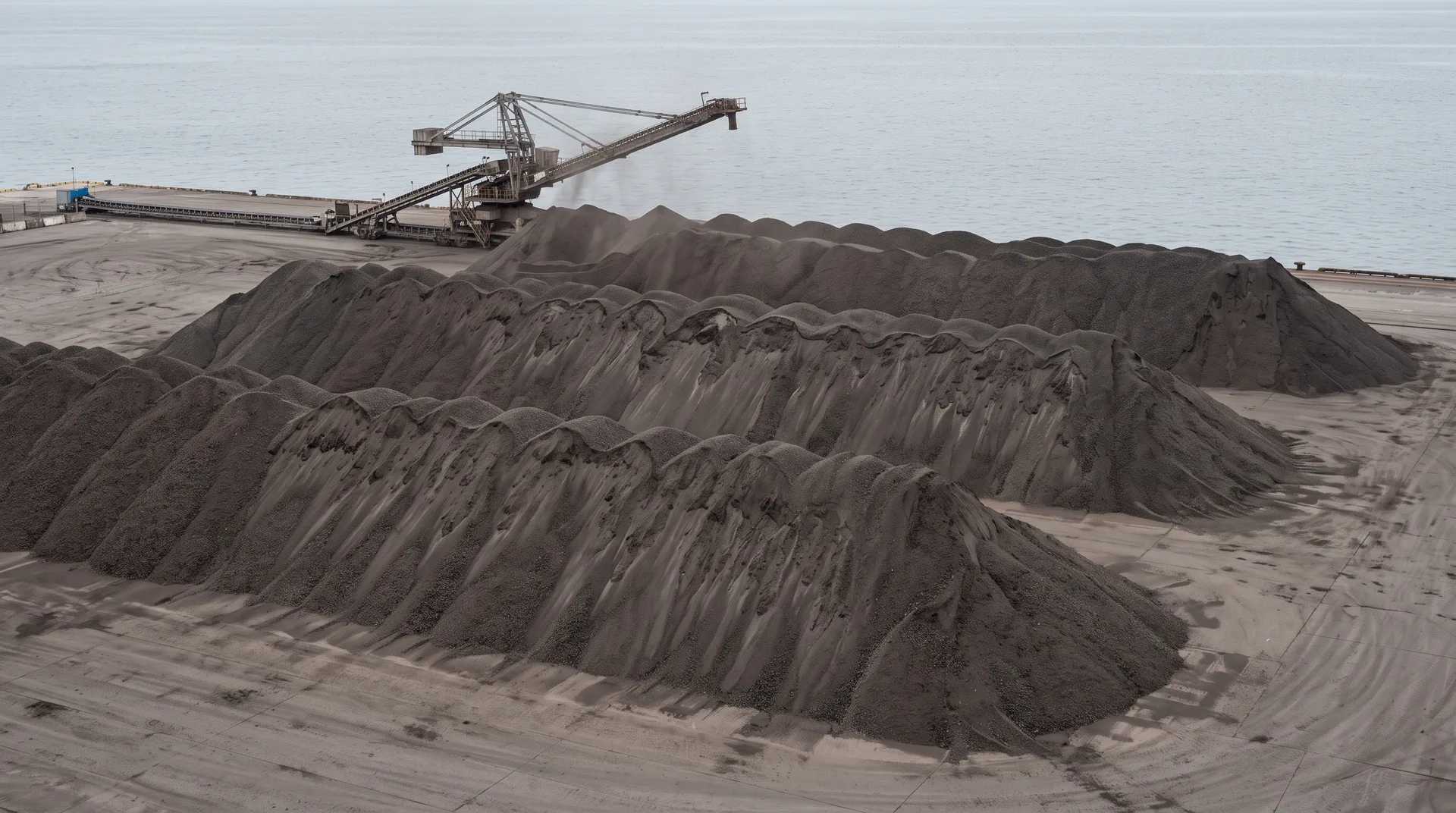
Open the 2026 Mineral Commodity Summaries at Titanium Mineral Concentrates and the ilmenite producers are listed as the United States, Australia, Canada, China, India, Madagascar, Mozambique, Norway, Senegal, South Africa and Ukraine, with a further line for other countries. Rutile is a shorter list: Australia, India, Kenya, Mozambique, Sierra Leone, South Africa and Ukraine. The production columns in both tables sit under an abbreviations line that reads "eEstimated. NA Not available. — Zero." — so the production figures carry the survey's own estimate marker, compiled, as its revisions note says, from "company reports, Government reports, news, or trade data". The chapter's own units line is worth reading before the numbers: data are "in thousand metric tons, titanium dioxide (TiO2) content, unless otherwise specified", so even the mine-stage table is denominated in contained oxide rather than in mineral as shipped.
Turn to the separate Titanium and Titanium Dioxide chapter and both the substance and the basis change. The table there carries sponge production for 2024 and 2025 alongside 2025 capacity for sponge and for pigment — metal and pigment, not mineral, and not on the mine-stage chapter's contained-TiO₂ basis. Its per-country rows are not reproduced here. No retrieved extract of the chapter carries its per-country sponge production rows, and a separate read of the same chapter records that its world totals row came back corrupted in conversion, so those rows need reading off the printed page before any country is named from them. Nothing is asserted here about which countries appear in that table, or with what figures. What the chapter does state in its own apparatus is how its cells are to be read: the abbreviations line defines a W as "Withheld to avoid disclosing company proprietary data", and the world total footnote reads "Excludes U.S. production."
That second footnote is the discontinuity in miniature, and it does not need the country list to make itself felt. A world total that has to exclude a country is the chapter saying, in the only place its apparatus allows, that one producer's figure is not in the number. The two chapters are otherwise joined by a cross-reference and by nothing a reader can carry a figure across: "See also the Titanium and Titanium Dioxide chapter." One is denominated in thousand metric tons of contained titanium dioxide out of the ground; the other in metal and in pigment, further along. A country that appears prominently in the first has told you what it digs, and nothing whatever about what it refines.
A country appears in the data at the step it performs. Ranking countries by a mineral is really ranking them by a stage, whether or not the ranking says so.
What the table is, and what it is not
Two habits of the data are worth carrying into any national comparison.
The first is that figures move between editions. The 2026 chapter notes that "Significant revisions were made to 2024 production for Australia, Madagascar, Sierra Leone, Ukraine, the United States, and 'Other countries' based on company reports, Government reports, news, or trade data" — and the revision is not always small. Australian ilmenite production for 2024 is given as 400 in the 2025 edition's table and 600 in the 2026 edition's, on the same thousand-tonne TiO2-content basis, for the same year. Neither number is wrong; the later one is better informed.
The second is that some cells are deliberately empty. A withheld figure protects a company, not a country, and it removes that country from the comparison entirely. When a national ranking is built from a table containing withheld cells, the ranking is of what could be published.
Where the frame runs out
Zircon has a producing-country table much like ilmenite's: the United States, Australia, China, Indonesia, Madagascar, Mozambique, Senegal, Sierra Leone and South Africa, plus other countries. Move down the same chain and the presentation changes shape completely. USGS describes zirconium and hafnium metal production not as a table of countries but as a sentence: metal "produced from zirconium chemical intermediates by one producer in Oregon and one in Utah". For hafnium the world column is absent altogether — world primary hafnium production data and quantitative estimates of hafnium reserves "were not available".
That is the country frame reaching its limit rather than failing. A stage performed at a handful of plants is not a national quantity, and a survey that declines to invent one is doing the reader a service. But it means that for the most concentrated steps in this mineral set — the steps where supply risk actually sits — there is no league table to compare, and any document that offers one has built it from somewhere other than the primary record.
The practical discipline follows from that. A national profile that says a country "produces titanium" has said almost nothing. A profile that says it produced titanium mineral concentrates, at an estimated figure, in a given data year, with the neighbouring stage performed elsewhere, has said something a reader can use — and has made visible the gap between the two, which is usually where the interesting question lives.
Related
- Mining Regions — the sub-national geology a country total averages over
- Processing Centres — where the second table's countries actually sit
- Processing Capacity — why the midstream list is so much shorter
- Global Trade — the customs categories these statistics are built from
- Government Agencies — the bodies that compile and revise national data
Sources
- PRIMARYU.S. Geological Survey, Mineral Commodity Summaries 2026 — Titanium Mineral Concentrates. World Mine Production and Reserves tables for ilmenite and rutile; abbreviations line 'eEstimated. NA Not available. — Zero.'; the revisions note for 2024 production; the cross-reference 'See also the Titanium and Titanium Dioxide chapter.'
- PRIMARYU.S. Geological Survey, Mineral Commodity Summaries 2026 — Titanium and Titanium Dioxide. World Sponge Metal Production and Sponge and Pigment Capacity table; abbreviations line including 'W Withheld to avoid disclosing company proprietary data.'; footnote 8 'Excludes U.S. production.'; the cross-reference 'Resources of titanium minerals are discussed in the Titanium Mineral Concentrates chapter.'
- PRIMARYU.S. Geological Survey, Mineral Commodity Summaries 2026 — Zirconium and Hafnium. Zircon world mine production table; 'World primary hafnium production data and quantitative estimates of hafnium reserves were not available.'; 'Zirconium metal and hafnium metal were produced from zirconium chemical intermediates by one producer in Oregon and one in Utah.'
- PRIMARYU.S. Geological Survey, Mineral Commodity Summaries 2025 — Titanium Mineral Concentrates. Used only for the prior-edition figure for Australian ilmenite production in 2024, to show the size of a between-edition revision.
- ANALYSISANALYSIS — the observation that a country's presence at the mine stage implies nothing about its presence at the metal stage is this publication's reading of the two USGS chapters set side by side. USGS prints no sentence to that effect; it prints only chapter cross-references. Note what is NOT claimed: the sponge chapter's per-country rows are NOT reproduced in this article and no comparison of the two country lists is offered, because no retrieved extract carries those rows and a separate read records the chapter's world totals row as corrupted in conversion; no source consulted characterises either list as complete; and both tables carry an 'estimated' marker on their production columns.Non-public document · no public URL