Minerals Hub / Applications & Industries / Monazite to magnets: the rare-earth supply chain
Applications & Industries · Monazite · 5 min read
Monazite to magnets: the rare-earth supply chain
The magnets that turn EVs and spin wind turbines run on a handful of rare earths — and monazite is one of the minerals they start from.
Reviewed by Peter Uppal
The short version
The strongest commercial permanent magnets, neodymium-iron-boron (NdFeB), drive electric-vehicle motors and wind-turbine generators, and they depend on rare earths — neodymium and praseodymium, plus dysprosium and terbium for heat resistance (US DOE, 2022). Monazite is a rare-earth phosphate mineral that is one primary source of those elements. Osmond reports Orión bulk monazite at 1.56–1.62% and a preliminary monazite concentrate grading 19.4% TREO (excl. Y) with 25% MREO (osm_zircon) — preliminary testwork, not a resource. Mineral percentages here are mass-balance estimates — calculated from oxide assays rather than directly measured — and that basis applies to every mineral percentage in this article.
Why these magnets matter
A permanent magnet is a quietly critical technology. The strongest commercially available type is neodymium-iron-boron, and it does something valuable: it packs a lot of magnetic force into a small, light package. That makes it the component of choice for the traction motors in electric vehicles and for the direct-drive generators in wind turbines, where every kilogram and every percentage point of efficiency counts (US DOE, 2022).
The rare earths in that magnet aren't interchangeable. Neodymium and praseodymium provide the baseline magnetic strength; dysprosium and terbium — "heavy" rare earths — are added in smaller amounts so the magnet keeps working at the high temperatures inside a motor (US DOE, 2022). Take those elements away and the magnet either weakens or overheats. This is why demand for a few specific rare earths tracks so closely with electrification.
The scale of dependence is easy to under-appreciate. On SCRREEN's figures (2016–2018 basis), the EU is about 100% import-reliant on separated rare earths — the category that includes the magnet elements — consuming roughly 4,734 t/yr of separated rare-earth compounds (REO-equivalent), with only token domestic separation (SCRREEN2 REE, via Osmond source-of-truth v7.0). That dependence sits against a supply chain concentrated overwhelmingly in China (USGS 2025; US DOE, 2022).
The supply chain, and where it bottlenecks
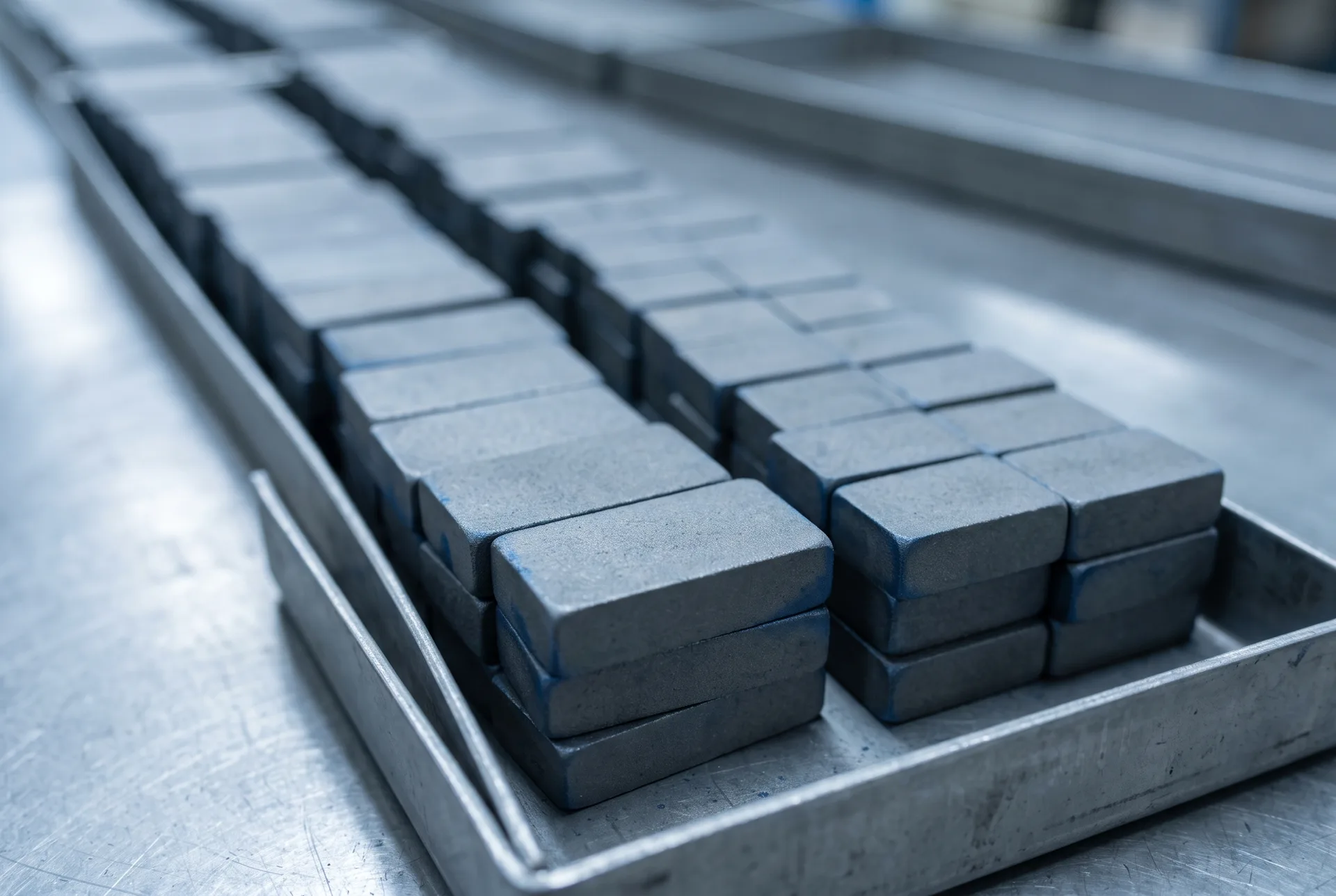
Getting from rock to magnet is a long chain, and every link is a place things can go wrong. Broadly, ore is mined, the rare-earth minerals are concentrated, then chemically separated into individual oxides, reduced to metals and alloys, and finally formed into magnets (US DOE, 2022).
The bottleneck isn't only mining. It's the middle of the chain — separation, metal-making and magnet manufacture — that is heavily concentrated in one country. According to the USGS, well over two-thirds of rare-earth mining and the large majority of oxide processing capacity sit in China (USGS 2025). For the heavy rare earths that give magnets their heat resistance, the concentration is even more extreme. That is the strategic anxiety driving Europe and others to look for new, non-Chinese sources at every stage — not just new mines, but new separation and processing capacity.
The magnet is only as secure as its weakest link — and for rare earths, the weak links are separation and processing, not just the mine.
Where monazite — and Orión — fit
Monazite is one of the minerals that can start this chain. As general mineralogy (not an Osmond figure), it is a rare-earth phosphate that concentrates the light rare earths, including neodymium and praseodymium, and it also contains thorium, which is why monazite handling carries radioactivity-management considerations in general.
For Orión specifically, only what Osmond has published applies. In the Zone 1 bulk channel samples, monazite runs 1.56% to 1.62% (mass-balance), with total rare-earth oxides (TREO) of 1.07% to 1.18% (osm_grade). More telling is the preliminary metallurgy: Osmond reports a monazite concentrate grading 19.4% TREO (excluding yttrium), including 25% MREO — the magnet-relevant rare earths, defined in that release as neodymium, praseodymium, dysprosium and terbium — at about 76% recovery — reported by Osmond as roughly a 20× upgrade, on the basis stated in that release (osm_zircon). At the element level, the AV-01bis interval reported neodymium oxide at 1,535 ppm and praseodymium oxide at 436 ppm, with dysprosium and terbium oxides far smaller at 113 ppm and 23 ppm (osm_grade).
Two cautions belong here. First, these are preliminary testwork and exploration results on a small sample, not a resource or a production spec. Second, "present in a concentrate" is a long way from "qualified magnet feedstock" — the full separation chain described above still has to be built and proven. What the numbers do show is why a monazite-bearing deposit is interesting at all: it sits at the very start of the chain the magnet world is trying to diversify.
Orión data card — Monazite
| Status | Assayed / quantified |
| Bulk channel samples | Monazite 1.56–1.62% (mass-balance); TREO 1.07–1.18% (osm_grade) |
| Preliminary concentrate | 19.4% TREO (excl. Y); 25% MREO (Nd, Pr, Dy, Tb); ~76% recovery; ~20× upgrade (osm_zircon) |
| Element detail (AV-01bis) | Nd₂O₃ 1,535 ppm; Pr₆O₁₁ 436 ppm; Dy₂O₃ 113 ppm; Tb₄O₇ 23 ppm (osm_grade) |
| Supply-chain role (general) | Monazite = light-REE phosphate, one feedstock at the start of the magnet chain (US DOE, 2022) |
→ See the full Monazite dossier in the mineral hub.
Exploration results and mineralogical estimates only. Orión has no JORC-compliant Mineral Resource or Reserve; maiden MRE and Scoping Study pending, targeted Q3 CY26.
Sources
- Osmond figures: [osm_grade — 19 Feb 2026], [osm_zircon — 3 Mar 2026] (ASX:OSM releases)
- US DOE — Rare Earth Permanent Magnets Supply Chain Deep Dive (2022)
- USGS Mineral Commodity Summaries 2025 — Rare Earths
- SCRREEN2 REE-EUROSTAT factsheet (Aug 2023), via Osmond source-of-truth v7.0 — EU ~100% import reliance; separated-REE consumption 4,734 t/yr (2016–2018 basis)
Related reading
- The monazite upgrade: what the preliminary testwork found (Science · Monazite)
- The rare-earth gap Europe can't recycle its way out of (Supply & the EU · Monazite)
- The accessory suite: xenotime, allanite and the trace rare earths (Science · Xenotime, Allanite)
Sources
- PRIMARYosm_grade — ASX:OSM release, 19 Feb 2026 (bulk-sample monazite and TREO grades Table 3; AV-01bis REE-oxide detail).
- PRIMARYosm_zircon — ASX:OSM release, 3 Mar 2026 (monazite concentrate 19.4% TREO excl. Y, 25% MREO (Nd, Pr, Dy, Tb), ~76% recovery, ~20× upgrade, p.1/p.4).
- SECONDARYUS DOE, 'Rare Earth Permanent Magnets: Supply Chain Deep Dive Assessment' (2022) — NdFeB in EV motors and wind turbines; Dy/Tb for heat resistance; supply-chain stages: https://www.energy.gov/sites/default/files/2022-02/Neodymium%20Magnets%20Supply%20Chain%20Report%20-%20Final.pdf
- PRIMARYUSGS Mineral Commodity Summaries 2025 — Rare Earths (China's share of mining and processing): https://pubs.usgs.gov/periodicals/mcs2025/mcs2025-rare-earths.pdf
- SECONDARYSCRREEN2 REE-EUROSTAT factsheet (Aug 2023), via Osmond source-of-truth v7.0 — EU ~100% import reliance on separated rare earths; oxide-stage EU consumption 4,734 t/yr (2016–2018 basis).