Minerals Hub / Mining & Production / What the record shows about handing a mine back
Mining & Production · · 5 min read
What the record shows about handing a mine back
Rehabilitation is measured against completion criteria, but the end point is relinquishment — and the published literature can name only a handful of sites that have reached it.
Pending review
The short version
Rehabilitation ends, formally, when a company is released from its liability and the land goes back — relinquishment. The Australian literature on whether this happens describes it as almost unknown: two peer-reviewed reviews, four years apart, between them name six sites across a continent with well over a century of mining, and only one site appears on both lists. No source consulted offers a national register, so the honest finding is not a low rate but an absent denominator.
What the question is
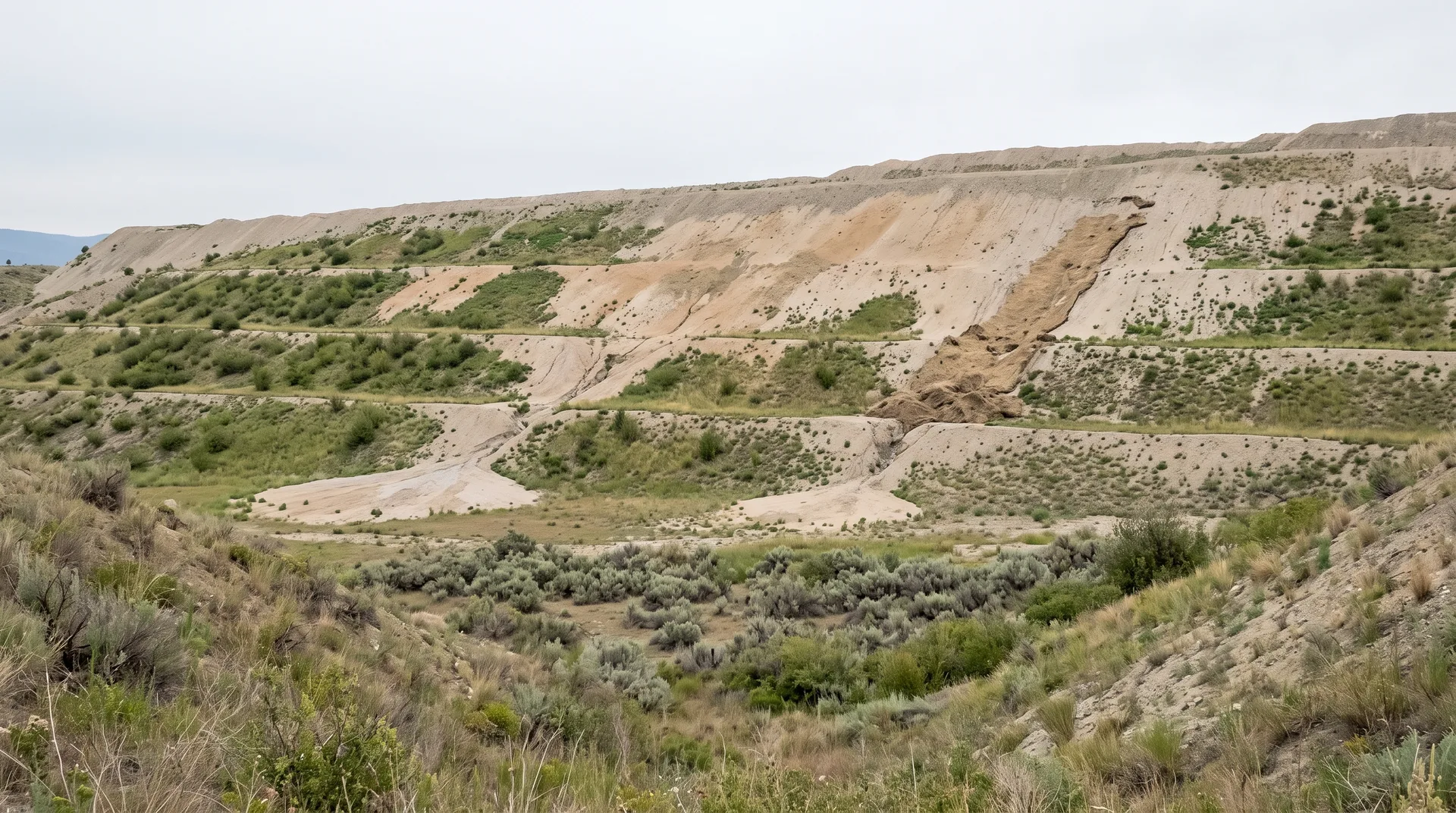
Completion criteria are the standards rehabilitation is judged against, and they are the visible part of the subject. Relinquishment is what they are for: the point at which a regulator accepts the work, the financial assurance is returned, tenure is surrendered, and the operator's liability ends.
The two are often discussed as though the second follows the first. The published record does not support that assumption, and the interest of the subject lies in how thin the record is.
What the sources say
Two reviews in the Australian Centre for Geomechanics' Mine Closure proceedings address relinquishment directly.
Tiemann and colleagues (2019) surveyed relinquishment policy across Australian jurisdictions. Their finding on the policy side is categorical: "A review of policy across Australia demonstrates that no clear pathway to relinquishment exists within mine closure legislation". On the empirical side they report "limited examples within Australia of mining operations closing successfully and allowing relinquishment of mine tenure", and identify three, drawn from DIIS (2016) — "Timbarra, Bottle Creek and Kestrel mines, however these are exceptions rather than the norm".
Purtill (2023) puts it more strongly still: "Mine closure, complete rehabilitation and relinquishment of the former mine site is almost unknown in Australia" (p. 5), with no examples of major, modern open-cut mines completing rehabilitation to the point where the site can be relinquished. His named cases are partly different. For Western Australia he lists three mines "the author identified" — "Bottle Creek gold mine, Jarrahdale bauxite mine and the Yoganup mineral sands project" (p. 6). For Queensland he identifies exactly one — New Hope Group's Chuwar thermal coal mine — adding that "no other mines in Queensland have been closed under contemporary environmental legislation" (p. 8). Timbarra, in New South Wales, he records as a site one landowner "accepted... back after the leases were sequentially relinquished in 2012" (p. 7).
What the two lists do, and do not, agree on
Set the named sites side by side and the overlap is one. Bottle Creek appears in both. Timbarra appears in Tiemann as a relinquishment example and in Purtill with a date attached. Kestrel appears only in the 2019 paper; Jarrahdale, Yoganup and Chuwar only in the 2023 one.
Two competent reviews of the same national question, four years apart, producing near-disjoint lists is itself a finding about the evidence. It is consistent with there being no authoritative register for either author to draw on — which is what both, in different words, report: Tiemann and colleagues note that "around Australia, there is similarly limited policy information on relinquishment provided by relevant regulatory agencies" (p. 1452).
For a mineral-sands publication, one entry is worth naming for a second reason. Yoganup is a mineral sands project, and it appears in Purtill's short list of Western Australian relinquishments — a data point of one, in a list of three, in a paper arguing the category is almost empty.
The literature cannot tell you how often mines are handed back. It can tell you that the people who went looking could not find out either.
Why the endpoint is hard to reach
The sources are more consistent on mechanism than on counts, and two obstacles recur.
The first is residual risk. Tiemann and colleagues state that government, industry and the community "need to understand and accept that residual risk and liability will exist in successfully closed post-mined land" — a landform can meet every agreed criterion and still carry a possibility of future failure. What that acceptance requires of the parties they name, and what it does to the pace at which relinquishment is granted, the paper does not set out.
The second is that financial assurance is built for operations, not for the decades after them. Assurance is held as "bonds, bank guarantees or annual levies, such as Western Australia's MRF levy" — instruments designed to be released. The scale they are held against is reported at one remove: the Department of Mines, Industry Regulation and Safety estimates a Western Australian mine rehabilitation liability of approximately $3 billion, based on figures reported under the Mining Rehabilitation Fund Act 2012, a departmental estimate Tiemann and colleagues relay rather than a figure of their own.
Where a post-closure obligation genuinely persists, a different instrument is needed. Both papers point to the same kind of answer: a post-closure trust fund, established in Victoria for the Stockman copper-zinc mine in 2017; Queensland's residual risk payments; and, outside Australia, the Saskatchewan mechanism, whose "transition phase" runs a "nominal minimum period 10 years" (Purtill, p. 5).
The limits of this evidence
Four constraints should travel with everything above.
The record is Australian. Neither paper is a global review, and nothing here should be read as describing practice in the European Union or anywhere else.
Both sources are conference papers in a peer-reviewed proceedings series. That is a legitimate literature and the standard venue for this subject, but it is not the same as a regulatory dataset.
The counts are named examples, not a census. Neither author claims to have enumerated every relinquishment, and the disagreement between their lists suggests neither could.
And the denominator is missing entirely. Without a register of sites that have completed rehabilitation, no completion-to-relinquishment rate can be calculated — which is why this article gives none.
Related
- Mining Methods — what has to be rehabilitated, and in what sequence
- Environmental Management — controls while an operation is running
- Community Engagement — the negotiation over what the land becomes
- Responsible Mining — the standards applied to closure
- Circular Economy — the argument for treating residues as material
Sources
- PRIMARYTiemann, C.D., McDonald, M.C., Middle, G. and Dixon, K.W., 'Mine relinquishment policy in Australia', in A.B. Fourie and M. Tibbett (eds), Mine Closure 2019, pp. 1451–1460, Australian Centre for Geomechanics, Perth. PAGE LOCATORS WITHHELD: three extraction passes over the same PDF returned contradictory pages for the same sentences, so the sentences are cited without page numbers rather than with an unverified one. Sentences relied on: limited Australian examples of operations closing successfully and allowing relinquishment of tenure; DIIS (2016) case studies including Timbarra, Bottle Creek and Kestrel, 'exceptions rather than the norm'; 'A review of policy across Australia demonstrates that no clear pathway to relinquishment exists within mine closure legislation'; 'Government, industry and the community need to understand and accept that residual risk and liability will exist in successfully closed post-mined land'; financial assurance as 'bonds, bank guarantees or annual levies, such as Western Australia's MRF levy'; 'The Department of Mines, Industry Regulation and Safety (DMIRS) estimates that Western Australia has a mine rehabilitation liability of approximately $3 billion based on figures reported under the Mining Rehabilitation Fund Act 2012' — an estimate, explicitly approximate, DMIRS's rather than the authors' own, Western Australia only; 'Establishment of a post-closure trust fund has occurred in Victoria for the Stockman copper-zinc mine in 2017'.
- PRIMARYPurtill, J.A., 'Re-thinking our model of mine rehabilitation and closure — is it time for a new model of mined lands stewardship?', in B. Abbasi, J. Parshley, A. Fourie and M. Tibbett (eds), Mine Closure 2023, Australian Centre for Geomechanics, Perth. Closure, complete rehabilitation and relinquishment described as almost unknown in Australia and no examples among major modern open-cut mines (p. 5); Bottle Creek gold, Jarrahdale bauxite and the Yoganup mineral sands project named for Western Australia, as three mines 'the author identified' rather than a register (p. 6); Chuwar the only Queensland relinquishment (p. 8); Timbarra — 'One underlying landowner, Forests NSW, accepted the site back after the leases were sequentially relinquished in 2012' (p. 7, confirmed against the full New South Wales passage); the Saskatchewan mechanism's 'transition phase (nominal minimum period 10 years)' and the Queensland residual risk payments, both at p. 5, not p. 4. The paper names the Saskatchewan process only through 'Application for Release from Decommissioning and Reclamation', the 'transition phase' and 'the two funds'.
- UNVERIFIEDGAP — a figure that approximately 70 per cent of Australian mine closures over the preceding 25 years were unplanned, attributed to ICMM (2019) via Purtill (2023, §3), was carried in an earlier draft and has been WITHDRAWN: extraction returned no content from Purtill's §3, so neither the figure nor its attribution could be confirmed, and the ICMM primary has not been read. The article now asserts nothing about how closures begin.Non-public document · no public URL
- UNVERIFIEDGAP — no systematic national register of relinquished mine sites was located for any jurisdiction. The counts below are the named examples two peer-reviewed conference papers were able to cite, not a census, and no source consulted claims to be one. A completion-to-relinquishment rate cannot be calculated from the published record and none is given here.Non-public document · no public URL