Minerals Hub / Mining & Production / How two properties sort four minerals
Mining & Production · Rutile · 6 min read
How two properties sort four minerals
The dry mill separates a heavy-mineral concentrate on magnetism and conductivity — and this particular assemblage happens to occupy four different places in that grid.
Reviewed by Peter Uppal
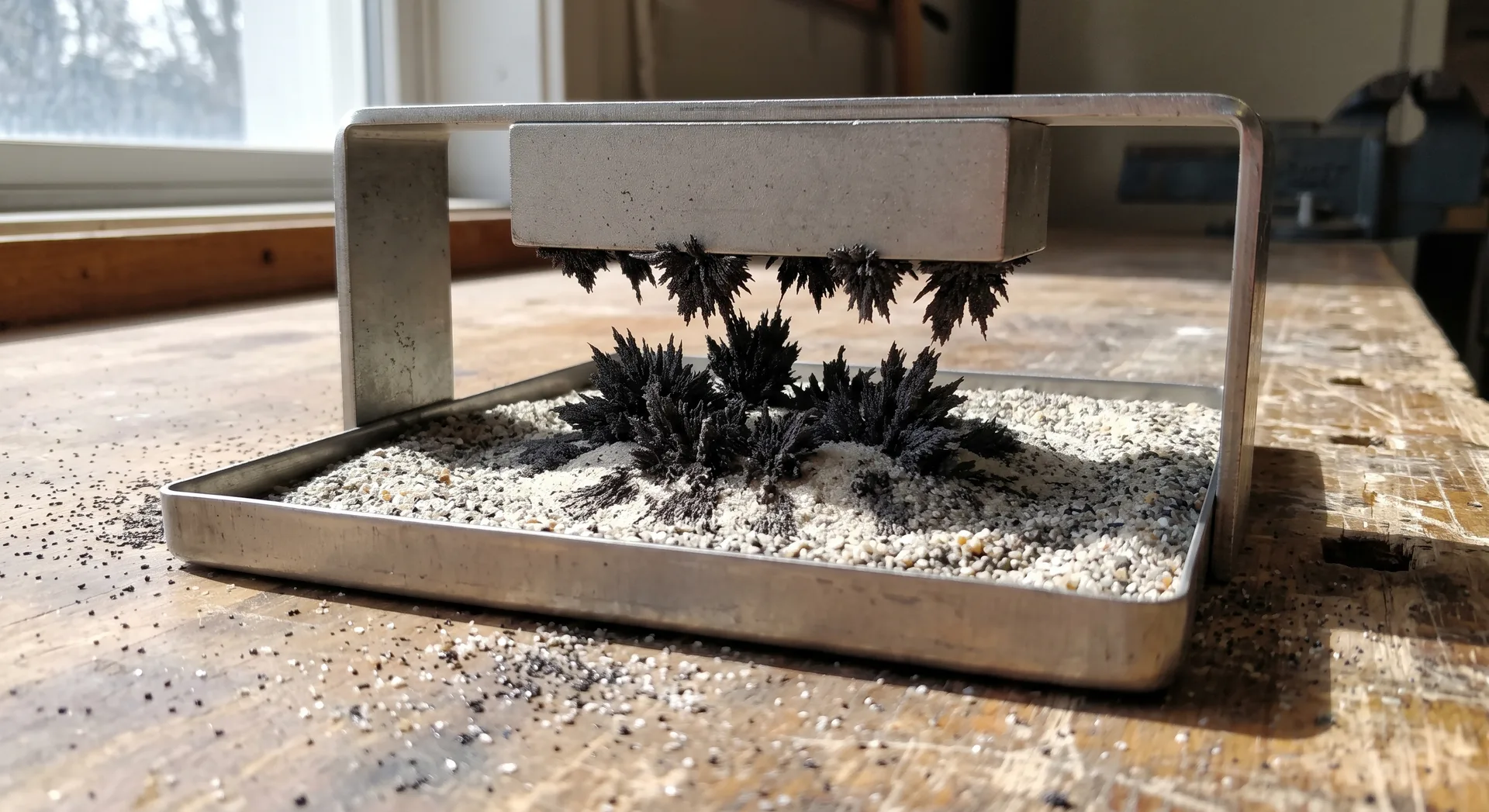
The short version
A mineral separation plant sorts a heavy-mineral concentrate using two physical properties: how a grain responds to a magnetic field, and whether it conducts electricity. A published review classifies the relevant minerals across both — ilmenite as ferromagnetic and paramagnetic, monazite as highly paramagnetic, zircon as diamagnetic, and rutile as a conducting mineral separated from zircon, which the same review calls non-magnetic and non-conducting. Four economic minerals landing in four different positions on those two axes is the reason this deposit type can be separated physically at all, and the places where the axes blur are where the flowsheet gets long.
Two axes, and why they are enough
Everything in a dry mill follows from a single fact about heavy minerals: they were concentrated by density, but they cannot be separated from one another by density, because they are all dense. Something else has to do the work.
The industry uses two properties. The first is magnetic susceptibility. A review of magnetic concentration describes low-intensity separators as attracting ferromagnetic mineral particles as concentrates, while high-intensity separators tend to attract and separate ferromagnetic as well as strong or highly paramagnetic mineral particles as concentrates, leaving diamagnetic or non-magnetic particles as the tailings of that stage. The second property is electrical conductivity, exploited by electrostatic separation, which the same review describes as recovering the conducting mineral portions, such as rutile, from zircon mineral sand, which is a non-magnetic and non-conducting mineral.
Two axes give four cells. The remarkable thing about a heavy-mineral assemblage is how neatly it fills them.
Where each mineral sits
Taking the review's own classifications: ilmenite is described as ferromagnetic and paramagnetic, which puts it on the magnetic side and makes it the easiest of the four to pull out first. Monazite is grouped with the highly paramagnetic minerals, alongside xenotime — so it too answers to a magnetic field, though only a strong one. Zircon is classified as diamagnetic, and the review states that zircon or other zirconium-associated minerals are usually recovered from the non-magnetic mineral portions. Rutile is where the second axis does its work: the review names it as the conducting mineral portion recovered by electrostatic concentration, separated from zircon, which it calls non-magnetic and non-conducting.
So the circuit almost writes itself. Split the concentrate magnetically and ilmenite and monazite part company with rutile and zircon; the review's own sentence pairs the two axes that way. Then split the non-magnetic half on conductivity and rutile parts company with zircon. Garnet, which the review classifies as paramagnetic and diamagnetic — that is, spanning both — is a reminder that the cells have soft edges.
At Orión the assemblage in question is exactly this one: Osmond's releases name rutile, ilmenite, zircon and monazite as the economic minerals, the four that occupy the four cells. What proportions they would arrive in, and what a plant built on them would look like, is a matter for the metallurgical programme rather than for this article.
A dry mill is a two-question interview. Are you magnetic, and do you conduct? Four minerals give four different answers, which is the only reason any of this works.
Where the grid stops being clean
Three complications matter, and a working plant is largely built out of them.
The first is that separators do not see minerals. As a general statement of how sorting works, the output of a comminution circuit is made of polymineralic, not monomineralic, ore particles; consequently, sorting devices do not act on pure mineral properties, but on particle properties. A composite grain answers both questions at once and lands in the wrong stream.
The second is alteration. Ilmenite is not a fixed thing. Iron is leached from it during weathering, upgrading the TiO₂ content of what remains and grading it towards leucoxene — and iron is what made it magnetic. No retrieved extract of the USGS deposit model carries that sentence, so it stands here as general mineral-sands geology rather than as a USGS finding. An altered ilmenite drifts across the magnetic axis toward rutile's position, so the cleanest split in the circuit is precisely the one weathering erodes. This is why a titanium product from a weathered deposit is often described as a mixed titanium stream rather than as ilmenite and rutile cleanly parted.
The third is surface. The same magnetic-separation review observes that mineral grains of certain heavy minerals may be coated with clay or iron oxides, which as a result may affect the physical properties of the minerals. A coated zircon grain can present a conductive surface it does not deserve. Scrubbing the grains before the dry stages is not housekeeping; it is what makes the second question answerable. As a general matter of industry practice, the feed to electrostatic separation is also dried and handled in controlled conditions, since surface moisture conducts — a point stated here without citation, because no source of sufficient standing could be verified for it.
Why the sorting has to be this good
The reason these distinctions repay the effort is that the products are sold on their mineralogy, not only on their chemistry. A study of mineralogical monitoring at a heavy-mineral operation describes a concentrate split into three commercial products through various processes in the mineral processing plant, and states that after separation each of the product streams must fulfil predefined specifications not only based on chemical composition but also mineral quantities.
That is a demanding standard, and it explains the length of a real flowsheet. It is not enough for a zircon product to assay well for zirconium. It has to be zircon, in the proportion the buyer specified, with the other three minerals left behind in whatever streams they belong to — which is the same two questions, asked over and over, in stages.
Exploration results and mineralogical estimates only. Orión has no JORC-compliant Mineral Resource or Reserve; maiden MRE and Scoping Study pending.
Sources
- JOM, 2024 — Physical Concentration of Heavy Minerals: magnetic separation process techniques (König et al.)
- Elements, December 2023 — All About Particles: Modelling Ore Behaviour in Mineral Processing
- Minerals (MDPI), 2021 — Heavy Mineral Sands Mining and Downstream Processing: Value of Mineralogical Monitoring Using XRD
- USGS SIR 2010-5070-L — Deposit model for heavy-mineral sands in coastal environments
- Osmond figure: osm_grade — 19 February 2026 (ASX:OSM release)
Related reading
- Breaking rock without breaking the grains covers the stage before this one, which determines what arrives at the separators.
- What a four-product plant asks of its controls takes up what happens when all four specifications have to be met at once, on a feed that changes.
- The separation nobody would do for hafnium alone follows one of these products past the point where physical sorting stops working.
- The monazite upgrade: what the preliminary testwork found (Science · Inside the testwork) reports what one of these four minerals did in Osmond's own testwork.
Sources
- PRIMARYNzeh, Popoola, Adeleke and Adeosun, 'Physical Concentration of Heavy Minerals: A Brief Review on Low and High Intensity Magnetic Separation Process Techniques', JOM, vol. 76 no. 3, 2024 (magnetic classification of heavy minerals; electrostatic separation of conducting from non-conducting minerals; surface coatings).
- PRIMARYPereira, Schach, Tolosana-Delgado and Frenzel, 'All About Particles: Modelling Ore Behaviour in Mineral Processing', Elements, vol. 19 no. 6, December 2023 (sorting devices act on particle properties, not pure mineral properties).
- PRIMARYKoenig and Verryn, 'Heavy Mineral Sands Mining and Downstream Processing: Value of Mineralogical Monitoring Using XRD', Minerals (MDPI) 11(11), article 1253, 2021 (heavy-mineral concentrate split into three commercial products; product streams must meet predefined specifications on chemical composition and mineral quantities).
- PRIMARYUSGS Scientific Investigations Report 2010-5070-L, Van Gosen and others, 'Deposit model for heavy-mineral sands in coastal environments' (2014). The leucoxene sentence formerly carried in this label is in no retrieved extract of the report and is no longer attributed to it in the body.
- PRIMARYosm_grade — ASX:OSM release, 19 February 2026 (economic minerals at Orión: rutile, ilmenite, zircon, monazite; bulk channel sample mineral percentages, mass-balance basis).
- UNVERIFIEDGAP: the requirement for a dry, low-humidity feed to electrostatic separation is widely described in trade and vendor material but no source of adequate standing could be verified at drafting. The point is stated in this article as general industry practice and carries no citation.Non-public document · no public URL