Minerals Hub / Mining & Production / Why topsoil is best moved only once
Mining & Production · · 6 min read
Why topsoil is best moved only once
Guidance prefers topsoil returned straight to a shaped surface rather than stored — which quietly makes rehabilitation a scheduling decision made years before anything is planted.
Pending review
The short version
Rehabilitation guidance prefers topsoil moved straight from where it is stripped to a surface ready to receive it, because storing it costs the soil the properties that make it worth saving. A trial in an arid Australian setting reported a trend toward 68% lower seedling emergence and 30% lower species richness from topsoil stored for two years, and a study of two British Columbian mines found chemical signatures of anaerobic conditions deeper in stockpiles. The same guidance concedes that direct transfer is often not feasible — which turns a soil-science preference into a mine-scheduling problem.
The preference, stated plainly
The Queensland Mine Rehabilitation Commissioner's review of topsoil practice puts the position without hedging the direction: ideally, topsoil should be directly returned to areas for use in revegetation rather than stored for later use. The reason given is not sentimental. Direct return avoids the loss of soil's essential properties, such as soil structure, organic matter, nutrients and microorganisms.
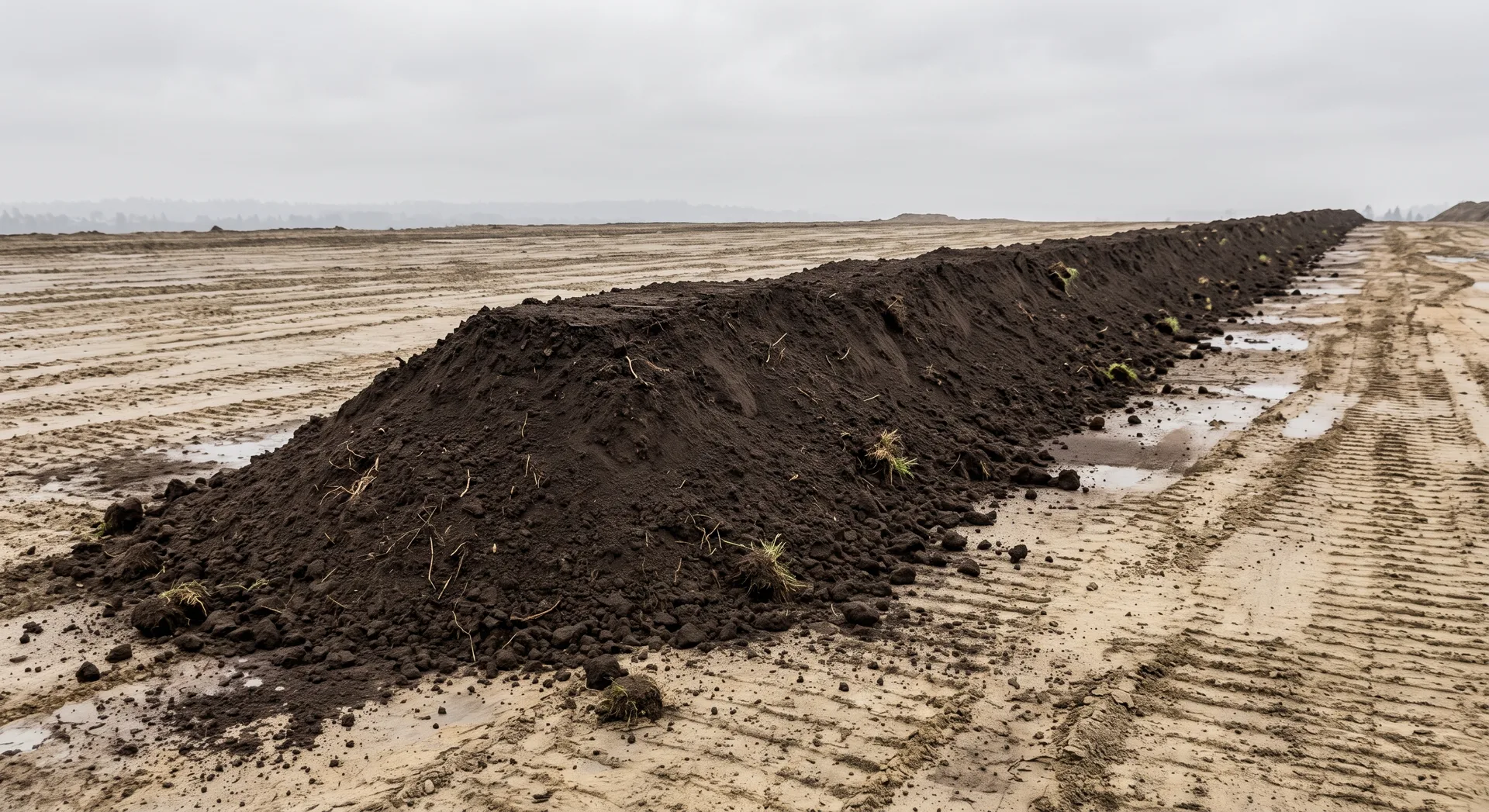
That list is the whole argument in miniature. Topsoil is not a material with a colour and a texture. It is a living assembly — structure that lets water and roots through, organic matter that holds nutrients, a seed bank, and a microbial and fungal community that the plants which will grow in it depend on. Move it once and most of that survives the trip. Park it in a heap and the clock starts.
What storage actually takes
Two lines of published work put shape on the loss, and both deserve to be read with their own qualifications attached.
The first is a stockpiling trial in an arid Australian environment. Comparing stored topsoil against directly returned topsoil, it reported a trend for lower seedling emergence, 68% lower, and species richness 30% lower, from topsoil stored for 2 years. Species-level results in the same study pull in opposite directions around that aggregate: after two years, seedling emergence of the grass Triodia basedowii was 13% of direct returned topsoil — a steeper fall than the headline — while emergence of the shrub Acacia stellaticeps was 68% of direct returned topsoil, a shallower one. The study's headline finding was that covering helped — seedling emergence from topsoil stockpiled for 2 years was more than 3.5-fold higher from covered topsoil stockpiles than uncovered — which is an argument for managing stockpiles well, not for treating them as harmless.
The second line of work concerns what happens inside the heap rather than on top of it. A study of two British Columbian operations found an accumulation of NH₄-N, Mn, and Zn with stockpile depth, suggesting anaerobic conditions, on the principle its authors state directly: topsoil buried deep in a storage pile may become anaerobic, which alters physical, chemical, and biological components of the soil. Its conclusion is that stockpile height was a key driver to the alterations of geochemical conditions, which will ultimately have implications for restoration success on mine sites.
The height guidance in that paper is worth quoting for what it reveals about the state of the practice: the results generally align with current best practice recommendations to keep topsoil stockpiles under 600 cm; although, some recommend stockpiles should remain below 130 cm. Six metres and one and a third metres are not variations on a single recommendation. They are different theories of what a stockpile is.
A stockpile is not storage. It is a slow process, and the thing it processes is the soil.
The part nobody schedules
Here is the consequence that is easy to miss, and it is offered as this publication's own reasoning rather than as a sourced finding, because no source consulted stated it outright.
Direct return is only possible if there is somewhere to put the soil at the moment it is lifted. That means a landform, already reshaped, already at final contour, waiting. Which means the rehabilitation programme has to run ahead of the stripping programme rather than behind it — and a rehabilitation surface is built out of material that itself has to be placed, settled and profiled first. The preference for moving soil once is therefore not a decision made by whoever handles the soil. It is made much earlier, by whoever sequences the mine, and it is made by default whenever nobody makes it.
The Queensland review is candid that this often does not happen: direct transfer is often not feasible, necessitating storage in stockpiles. It does not say why, and the honest reading is that the reasons are usually about sequence and space rather than about soil.
Why mineral sands sits well here, in principle
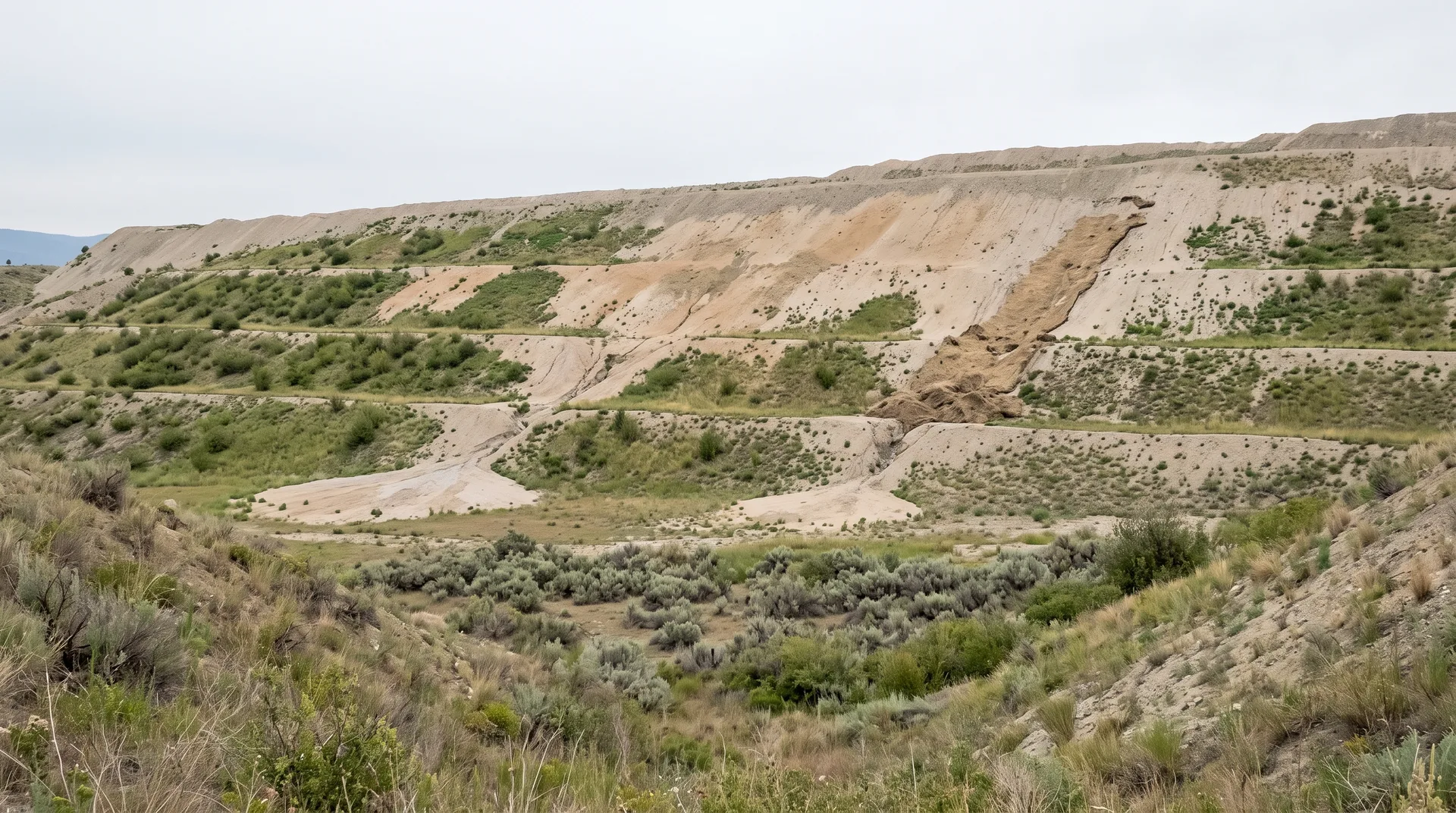
An operation whose face advances laterally rather than deepening in one place has the geometry this asks for: ground is opened in front and closed behind at the same time. Victoria's public-information page on restoring land after mineral sands mining describes exactly that arrangement, stating that mining companies are required to restore parts of the site as mining progresses and that after each section is mined, workers replace the sand and soil in the correct order.
"In the correct order" is doing real work in that sentence. Topsoil and the material beneath it are stripped as separate lifts and returned as separate lifts, because putting them back inverted buries the biologically active layer under the inert one — an outcome that looks finished from a distance and behaves like subsoil for a long time.
What the evidence supports, and how far
It is worth being precise about the reach of the two studies above. One is an arid Australian site reporting a trend across two named species. The other is two mines in British Columbia, examining a geochemical signature rather than a plant outcome. Neither is a mineral-sands operation, and neither is in a Mediterranean-climate farming region.
What they support well is the direction: storage degrades topsoil, deeper storage degrades it more, and longer storage degrades it further. What they do not support is a number that can be carried to a different climate and soil. An operator planning rehabilitation in southern Spain would be reading these as evidence that the question matters, and would need local trial data to answer it. Osmond has published nothing on closure or rehabilitation for Orión, and the maiden Mineral Resource Estimate and Scoping Study that would ordinarily frame such planning are pending.
Exploration results and mineralogical estimates only. Orión has no JORC-compliant Mineral Resource or Reserve; maiden MRE and Scoping Study pending.
Sources
- Queensland Mine Rehabilitation Commissioner — Review of techniques to address topsoil deficit in open cut coal mines under rehabilitation in Queensland: Student report
- Golos and Dixon (2014), Restoration Ecology 22(4) — Waterproofing topsoil stockpiles minimizes viability decline in the soil seed bank in an arid environment
- Fischer and others (2022), Mining 2(2) — Impacts from Topsoil Stockpile Height on Soil Geochemical Properties in Two Mining Operations in British Columbia
- Resources Victoria — Restoring land after mineral sands mining
Related reading
- Automating a mine that keeps moving covers the same lateral geometry from the operating side.
- Breaking rock without breaking the grains explains what a lithified host changes about the material that eventually has to be put back.
- What the record shows about handing a mine back (Mining & Production · Rehabilitation) takes up what happens at the far end of this sequence, and how little of it is published.
Sources
- PRIMARYQueensland Mine Rehabilitation Commissioner, 'Review of techniques to address topsoil deficit in open cut coal mines under rehabilitation in Queensland: Student report' (February 2024, version 1.1 released 19 November 2024) (direct return preferred over storage; properties lost in storage; direct transfer often not feasible; desiccation and decline in microbial activity).
- PRIMARYGolos, P. and Dixon, K., 'Waterproofing topsoil stockpiles minimizes viability decline in the soil seed bank in an arid environment', Restoration Ecology 22(4), 2014, pp.495-501 (seedling emergence and species richness after two years of storage, relative to direct-returned topsoil; covered versus uncovered stockpiles). Arid Australian setting.
- PRIMARYFischer, Van Hamme, Gardner and Fraser, 'Impacts from Topsoil Stockpile Height on Soil Geochemical Properties in Two Mining Operations in British Columbia: Implications for Restoration Practices', Mining (MDPI) 2(2), 2022 (anaerobic conditions in deep piles; accumulation of NH4-N, Mn and Zn with depth; stockpile height recommendations).
- PRIMARYResources Victoria (Department of Energy, Environment and Climate Action), 'Restoring land after mineral sands mining', page dated 21 May 2026 (progressive restoration requirement; replacement of sand and soil in the correct order).
- UNVERIFIEDGAP: no source could be located stating explicitly that direct return constrains the mining schedule by requiring a shaped receiving surface at the moment soil is lifted. That inference is this publication's own and is marked as such in the text.Non-public document · no public URL