Minerals Hub / Applications & Industries / The few metres of doped glass under the ocean
Applications & Industries · · 4 min read
The few metres of doped glass under the ocean
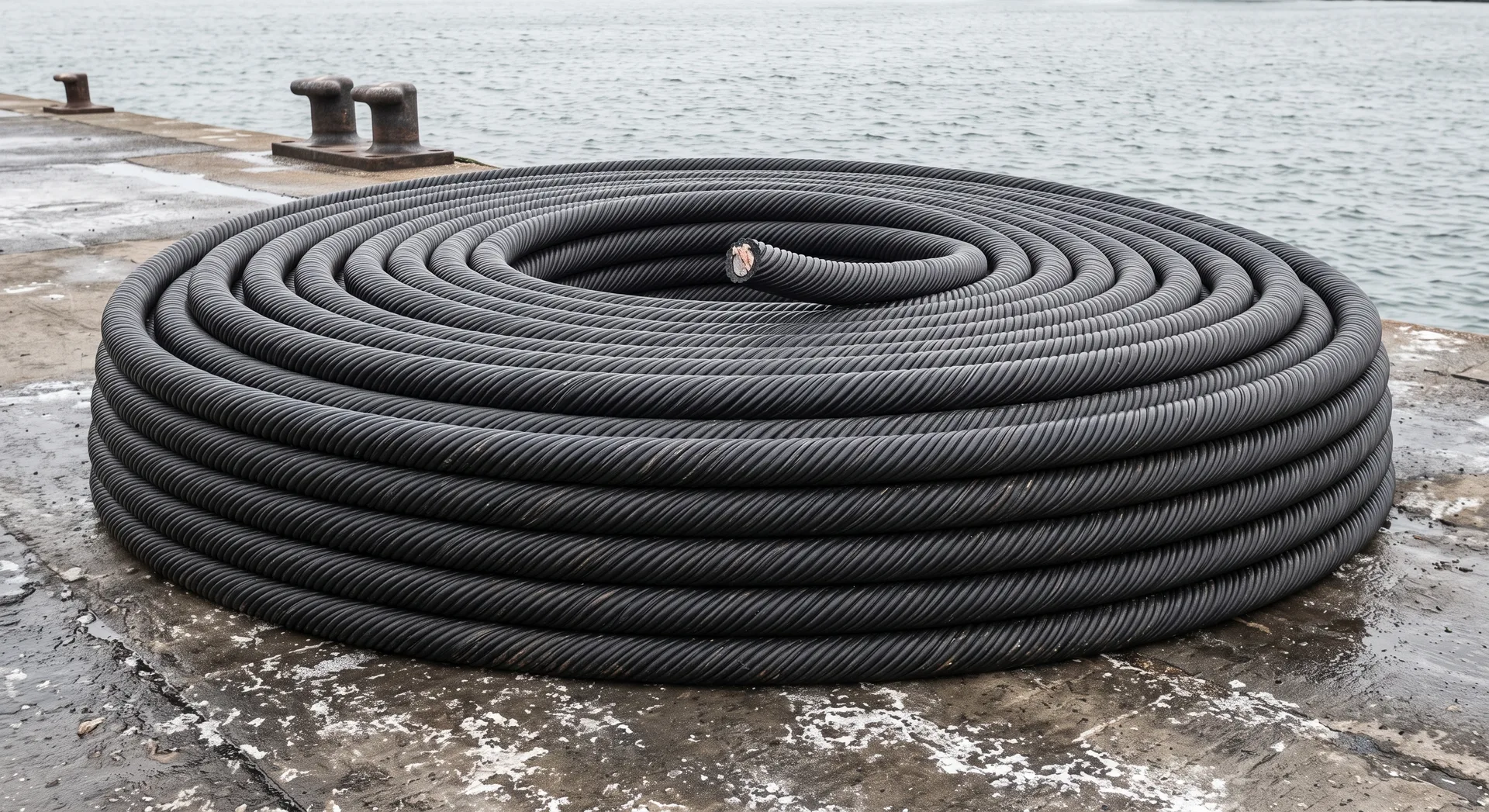
Submarine cables carry light for thousands of kilometres because every seventy-five to a hundred kilometres it passes through a short length of glass containing a rare earth.
Pending review
The short version
Glass is very good at carrying light and still not perfect: a modern single-mode fibre is specified at a maximum of 0.18 dB/km at 1550 nm, which is superb and still fatal over an ocean. The fix is amplification along the way, and in submarine systems it happens roughly every 75–100 km, inside a short segment of fibre doped with erbium — a fiber segment a few meters long. The internet's long-haul physics rests on a rare earth measured in metres of glass.
How good the glass had to get
The whole industry turned on an attenuation figure. An Optica history records the moment: measurements in 1970 that brought fibre loss down to 17 dB/km, and two weeks later 16.9 dB/km — losses that made long-distance optical transmission arguable for the first time. Half a century later the same source reports that the loss in mass-produced single-mode fiber 'is now only 0.17 dB/km', a figure it gives as of March 2020.
The standards and the products have separated in an instructive way. ITU-T G.652 sets, for the widely deployed G.652.D fibre, a maximum of 0.30 dB/km across 1530–1565 nm; a current commercial product sheet specifies ≤ 0.18 dB/km at 1550 nm. The standard describes what a fibre must not exceed; the datasheet describes what a manufacturer will guarantee. They are different numbers doing different jobs, and conflating them overstates either the standard or the product.
Even at 0.18 dB/km, distance wins. A few hundred kilometres of that loss leaves nothing usable at the far end, and an ocean is several thousand.
Why the amplifier is made of the same stuff as the cable
The elegant part of the solution is that the amplifier is not a separate machine bolted into the line. It is more fibre — with something added. ITU-T's classification of optical fibre amplifiers identifies its first category as OFAs using silica-based fibres doped with erbium ions to produce an active fibre: the amplifier is a doped length of the same silica the cable is made of.
How short a length is the surprising part. A university teaching text describes it as a fiber segment a few meters long, doped with Er (and usually co-doped with Al and Ge). Everything between two amplifier huts is passive glass; the active element is metres of it.
The wavelength band matters because erbium's useful behaviour sits in a particular window, and that window is what the industry standardised around. ITU-T records that the 'conventional' C-band 'has a spectral width of 35 nm (1 530-1 565 nm)', with the S-band below it and the L-band above. It is a narrow slice of spectrum, and a great deal of engineering has been arranged to fit inside it.
The long-haul network is thousands of kilometres of ordinary glass, punctuated every so often by a few metres of glass with an element in it.
What the record does not establish
Two things this article deliberately does not claim. First, the amount of erbium involved. No source read here states a doping concentration in parts per million or ions per cubic centimetre; erbium-doped fibre is specified commercially by absorption in dB per metre, which is a performance figure and not a composition. The mass of erbium in an amplifier is therefore small in a way that can be described but not quantified from anything read.
Second, the mechanism in its usual shorthand. Optical amplification is routinely explained as boosting the light without converting it to an electrical signal and back, and no citable source obtained for this article states that in those words — the ITU Recommendation uses the term 'optical fibre amplifier' without defining it. What is sourced is the institutional description of the invention: Southampton's citation for the world's first practical optical amplifier — the Erbium-Doped Fibre Amplifier.
Even the date is not settled by the institution that made the claim. One Southampton page states that the EDFA was 'developed in 1987'; another, describing the same researcher's work, says the team in 1985 first announced the silica fibre laser and the Erbium-Doped Optical Amplifier. Both are published by the same university, and both are reproduced here.
Scale, and the mineral end
The infrastructure this supports is countable. TeleGeography reports 570 in-service systems, with another 81 planned, noting that the number of in-service systems is greater now than in any other year within the last two decades — in-service systems, most of which are not transoceanic, so the figure should not be upgraded into a count of ocean crossings.
The mineral connection runs through the silica rather than the erbium. In Osmond's portfolio silica and high-purity quartz sit as a stated forward interest with no published resource data — a status label, not a grade — and no figure exists that this article could responsibly attach to fibre manufacture. The erbium end has no Orión figure either: erbium is not among the elements the company has quantified.
Related
- Silica/HPQ — the material behind the fibre, and its status in this portfolio
- Rare Earths — the separation chemistry that produces a single element
- Space — the satellite half of the same communications question
Sources
- PRIMARYUniversity of Southampton, 'Millennium Technology Prize' news item, April 2008 — 'The EDFA, developed in 1987, is widely regarded as one of the most significant developments in modern telecommunications'; recognition of Professor David Payne, Dr Randy Giles and Professor Emmanuel Desurvire for 'pioneering research developing the world's first practical optical amplifier - the Erbium-Doped Fibre Amplifier (EDFA)'.
- PRIMARYUniversity of Southampton, 'Professor Sir David Payne' staff profile (undated) — 'He led the team that in 1985 first announced the silica fibre laser and the Erbium-Doped Optical Amplifier (EDFA)…'. The same institution publishes both 1985 and 1987 for the same development; both are quoted and neither is preferred.
- PRIMARYITU-T G-series Recommendations, Supplement 42, October 2018 — 'The 'conventional' C-band defined in Supplement 39 to ITU-T G-series has a spectral width of 35 nm (1 530-1 565 nm)'; S-band 1 460–1 530 nm and L-band 1 565–1 625 nm; and the near-elimination of the OH absorption peak around 1 380–1 410 nm.
- PRIMARYRecommendation ITU-T G.661 (03/2006), classification of optical fibre amplifiers — category 'A' identified as 'OFAs using silica-based fibres doped with erbium ions to produce an active fibre'. The Recommendation uses the terms without giving standalone definitional clauses; no definition is quoted here.
- PRIMARYAlmeida, R.M., 'Optical Amplification in Optical Fiber Systems', Lecture 26, International Materials Institute for New Functionality in Glass, Lehigh University, Spring 2005 — 'The EDFA is a fiber segment a few meters long, doped with Er (and usually co-doped with Al and Ge).'
- PRIMARYPapapavlou, C., Paximadis, K., Uzunidis, D., Tomkos, I., 'Toward SDM-Based Submarine Optical Networks: A Review of Their Evolution and Upcoming Trends', Telecom (MDPI) 3(2):234–280, 11 April 2022 — repeaters 'installed every 75–100 km, which provide the necessary amplification for optical signals'.
- SECONDARYTeleGeography, 'How Many Submarine Cables Are There, Anyway?' — '570 in-service systems, with another 81 planned' as of 2025, and that 'the number of in-service systems is greater now than in any other year within the last two decades'. In-service systems, not transoceanic cables; page revision date not captured.
- PRIMARYCorning Incorporated, 'Corning SMF-28 Ultra single-mode optical fibers' Product Information sheet PI-1424-AEN, issued July 2025 — maximum attenuation '≤ 0.18' dB/km at 1550 nm and '≤ 0.32' dB/km at 1310 nm. These are maxima, not typical values.
- PRIMARYRecommendation ITU-T G.652 (08/2024), 'Characteristics of a single-mode optical fibre and cable', clause 8, Tables 1 and 2 — for G.652.D, 'Maximum from 1310 nm to 1625 nm 0.40 dB/km' and 'Maximum at 1530-1565 nm 0.30 dB/km'.
- SECONDARY'The Breakthrough Birth of Low-Loss Fiber Optics', Optics & Photonics News (Optica), Volume 31, March 2020 — 'The loss in mass-produced single-mode fiber is now only 0.17 dB/km' (as of March 2020), and the 1970 measurements of 17 dB/km and 16.9 dB/km.
- UNVERIFIEDGAP — no source read for this article gives an erbium doping concentration in ppm or ions per cubic centimetre, and none gives the mass of erbium in an amplifier. A manufacturer's datasheet specifies erbium-doped fibre by absorption in dB/m rather than by concentration. The quantity of erbium involved is therefore described qualitatively only.Non-public document · no public URL
- UNVERIFIEDGAP — no citable source was obtained stating in plain terms that an erbium-doped fibre amplifier boosts the optical signal without converting it to an electrical form, and no numeric purity specification for fibre-preform silica was obtained. ITU-T G.661 uses the term 'optical fibre amplifier' without a definitional clause, and general accounts of fibre purity read for this article are qualitative.Non-public document · no public URL
- ANALYSISOURS — this publication's status label for silica and high-purity quartz in the Osmond portfolio: strategic-interest / forward-focus, with no published resource data. Not a released figure, and no grade or tonnage exists to cite.Non-public document · no public URL