 ASX: OSM · Orión Project
Minerals Hub / Elements / Zirconium
Zr · element
Zirconium
Carried in — the Orión minerals that yield it
What it is
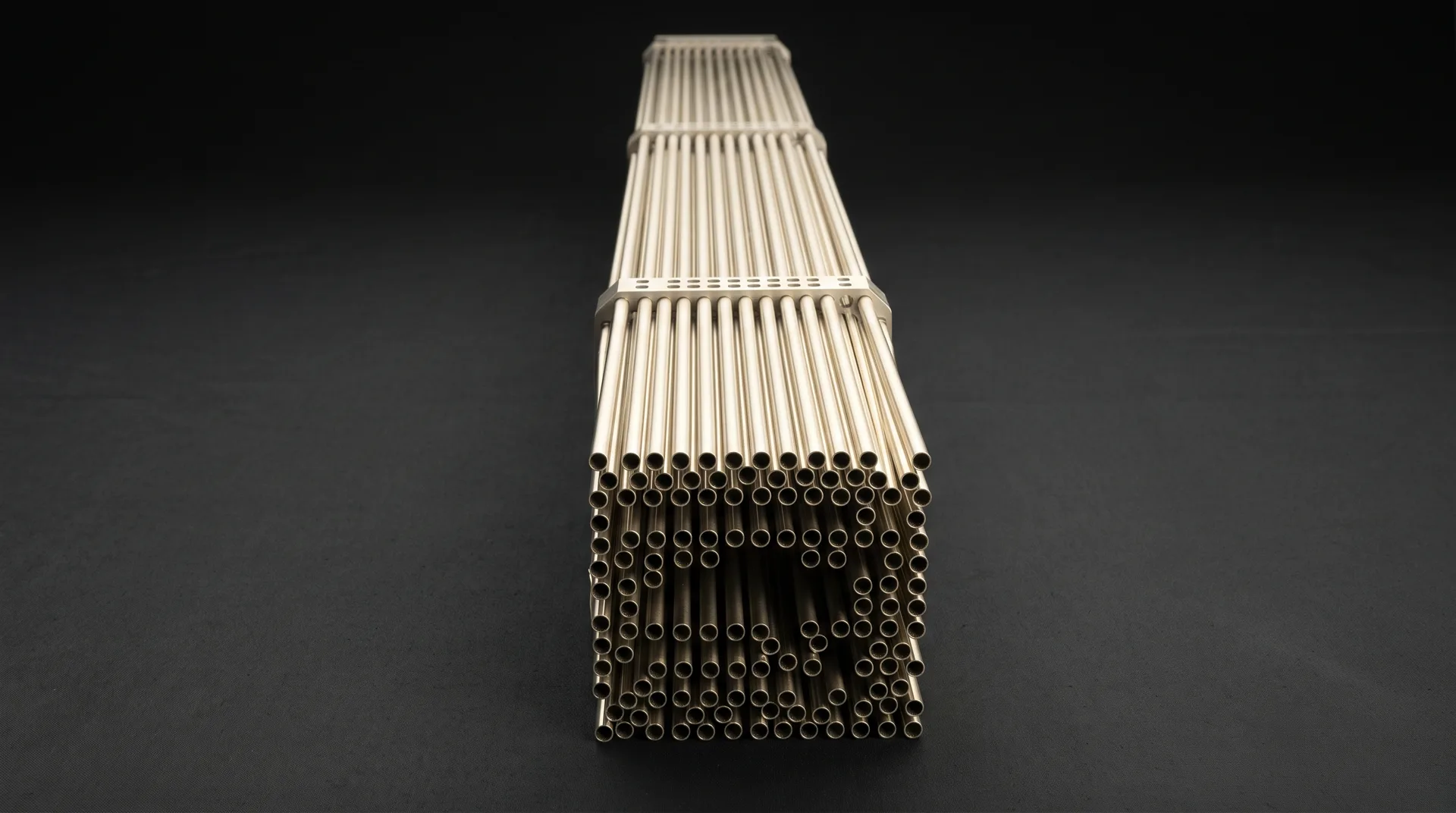
Zirconium is element 40 on the periodic table, sitting in group 4 and period 5 of the d-block — a lustrous transition metal. Its electron configuration is [Kr] 4d² 5s², with electrons arranged in shells of 2, 8, 18, 10 and 2, and its standard atomic weight is 91.222(3). In appearance it is a grey-white, lustrous metal that closely resembles hafnium and, rather less so, titanium.
The name comes from the mineral zircon, which reaches English through German Zirkon — Klaproth's 1789 coinage — and eighteenth-century French jargon, from Medieval Latin jargonce. Beyond that the trail is contested: Etymonline records the origin as uncertain and notes an Arabic zarkun meaning cinnabar, while other reference sources give zargun, "gold-coloured", attributing it variously to Arabic or Persian. The element was identified in 1789 by Martin Heinrich Klaproth, working from a zircon specimen from Ceylon — though Klaproth never isolated the metal itself. That came in 1824, when Jöns Jacob Berzelius produced an impure sample by heating potassium together with potassium zirconium fluoride.
Properties
Zirconium melts at 1855 °C and boils at roughly 4410 °C, placing it firmly among the refractory metals. (Boiling points at these temperatures are difficult to pin down, and the figure should be treated as approximate.) Its density is about 6.5 g/cm³ at room temperature, its molar heat capacity 25.36 J/(mol·K), and its thermal conductivity 22.6 W/(m·K). On the Pauling scale its electronegativity is 1.33.
The metal is allotropic — it rearranges its crystal structure with temperature and pressure. At room temperature it takes the α form, a hexagonal close-packed structure with lattice parameters a = 323.2 pm and c = 514.7 pm. On heating, high-purity zirconium converts from α to the body-centred cubic β form at approximately 863 °C, but this temperature is sensitive to impurities — oxygen especially — and can shift upward by as much as 90 °C. Under high pressure a third allotrope appears: the simple-hexagonal ω-phase, with the α→ω transition occurring near 2.10 GPa at 300 K.
Chemically, zirconium is dominated by the +4 oxidation state, though 0, +1, +2, +3 and even −2 have been observed. Its defining practical trait is corrosion resistance: the metal grows a thin, adherent, self-passivating oxide layer that shields it from alkalis, acids and salt water. It also takes up oxygen, nitrogen and hydrogen in large quantities, a property historically exploited to scavenge residual gases from electron tubes. In powdered form zirconium is highly flammable; the solid metal is far less prone to ignition.
Natural zirconium has a low thermal-neutron capture cross-section of about 0.18 barn — an abundance-weighted total across its isotopes rather than a property of the element as such, and the reason the natural mix serves as cladding without enrichment. It does absorb neutrons — only weakly, and that weakness is what makes it valuable in reactors.
Four isotopes are stable — ⁹⁰Zr, ⁹¹Zr, ⁹²Zr and ⁹⁴Zr — alongside primordial ⁹⁶Zr, which decays by double beta decay with a half-life of 2.34×10¹⁹ years. ⁹⁴Zr is observationally stable. The most abundant isotope is ⁹⁰Zr, at 51.5%.
Occurrence
The principal source of zirconium is the silicate mineral zircon, ZrSiO₄. Baddeleyite, a naturally occurring zirconium dioxide, is a minor secondary source. Zircon turns up as an accessory mineral in many rock types, but essentially all recovery comes from placer and heavy-mineral-sand deposits, where it is obtained as a coproduct or byproduct alongside ilmenite, rutile or tin minerals. Commercial concentrate is typically specified around 65%, stated as ZrO₂ plus HfO₂ combined rather than ZrO₂ alone — the two elements are not separated at this stage. Stoichiometrically pure zircon is 67.2% ZrO₂ by mass.
Hafnium invariably accompanies zirconium in zircon, typically at roughly 34–36 to 1 by mass per USGS technical publications (a legacy figure of about 50 to 1 persists on USGS overview pages). A 1992 assessment placed about 71% of identified economically exploitable zirconium resources in South Africa, Australia and the United States.
Zircon has a second scientific life as a timekeeper: detrital crystals from the Jack Hills of Western Australia have been dated to about 4.4 billion years, making them among the oldest known terrestrial materials.
Applications
Zirconium alloys — Zircaloy being the familiar family name — serve as cladding for nuclear fuel, combining weak neutron capture with corrosion and heat resistance. The metal also appears in chemical piping, heat exchangers and process equipment exposed to corrosive conditions.
Most zircon, however, never becomes metal. Its major end uses are refractories, foundry and casting sands, and ceramic opacification. Cubic zirconia, a form of ZrO₂, is a widely used diamond simulant: softer than diamond but denser, at 6.0 g/cm³ against 3.52.
Pure zirconia passes through a sequence of phases on heating — monoclinic, then tetragonal near 1173 °C, then cubic near 2370 °C, melting around 2690 °C. Stabilising it with yttria yields a ceramic with high fracture toughness (7–10 MPa·m⁰·⁵) through transformation toughening, used in cutting tools, dental and biomedical implants, thermal-barrier coatings, oxygen sensors and solid-oxide fuel cell electrolytes. Bulk zirconia's melting point near 2700 °C and low thermal conductivity of roughly 2–3 W/(m·K) suit it particularly well to thermal barriers.
Industrial importance
Zirconium's industrial value is a direct reading of its physics. The self-passivating oxide layer is why it handles acids, alkalis and salt water in chemical plant. The low neutron cross-section, paired with that same corrosion resistance and heat tolerance, is why it clads reactor fuel — and why the near-inseparable hafnium, hundreds of times hungrier for neutrons, has to be stripped out first. Its oxide contributes a different set of virtues: extreme melting temperature, poor heat conduction and, when stabilised, unusual toughness for a ceramic, which together underpin refractories, thermal-barrier coatings and load-bearing implants. Few elements carry so much of their usefulness in a single property list.
How it is extracted
The dominant industrial route cracks the ore, converts the zirconium to the tetrachloride ZrCl₄, and reduces that with magnesium under an inert atmosphere — the Kroll process. A second, older method is the Van Arkel–de Boer or crystal-bar process, in which zirconium tetraiodide is thermally decomposed on a hot filament; it was the first industrial route, dating to 1925, and survives for small ultra-pure batches.
Nuclear applications add a step: hafnium must be removed, since nuclear-grade zirconium requires less than 100 ppm hafnium. The reason is stark — the thermal-neutron capture cross-sections stand at about 104 barns for hafnium against 0.18 for zirconium, some 600 times greater. The separation methods and the chemistry behind them are covered on the hafnium page.
- SECONDARYWikipedia — Zirconium; Isotopes of zirconium; Yttria-stabilised zirconia
- PRIMARYCIAAW 2024 — standard atomic weight; isotopic abundance
- PRIMARYCRC Handbook of Chemistry and Physics — melting point, boiling point, density, flammabilityNo public URL · citation pending
- SECONDARYRoyal Society of Chemistry (RSC) — naming, discovery, corrosion, nuclear use, cubic zirconia
- SECONDARYOnline Etymology Dictionary — 'zircon': German Zirkon, French jargon, Medieval Latin jargonce
- PRIMARYArblaster 2018 — α-Zr lattice parametersNo public URL · citation pending
- PRIMARYSchnell & Albers 2006 — α→β transition temperature
- PRIMARYJaworska et al., Materials 12(14), 2244, 2019 — α→ω transition at 2.10 GPa, 300 K
- SECONDARYEncyclopaedia Britannica — gas absorption / getter use
- PRIMARYSears, V. F., Neutron News 3(3), 26–37, 1992 — neutron scattering lengths and cross sections
- PRIMARYUSGS — zircon as principal source; coproduct recovery; industrial uses; Hf:Zr ratio (PP 1802, MCS 2024)
- PRIMARYUSGS Minerals Yearbook 2021 — baddeleyite as secondary source
- PRIMARYUSGS Circular 930-L (1992 assessment) — placer occurrence; resource distribution
- PRIMARYWilde et al. 2001 (Nature); Valley et al. 2014 — Jack Hills detrital zircons
- PRIMARYXu et al. 2015, J. Nucl. Mater. — chloride/Kroll route
- PRIMARYvan Arkel & de Boer, Z. anorg. allg. Chem. 148(1), 345–350, 1925 — crystal-bar process
- SECONDARYZircon Industry Association — concentrate specification (ZrO₂ + HfO₂ combined)
- PRIMARYHan, J. Korean Ceram. Soc. 61(5), 783–799, 2024 — zirconia phase sequence