 ASX: OSM · Orión Project
Minerals Hub / Elements / Hafnium
Hf · element
Hafnium
Carried in — the Orión minerals that yield it
What it is
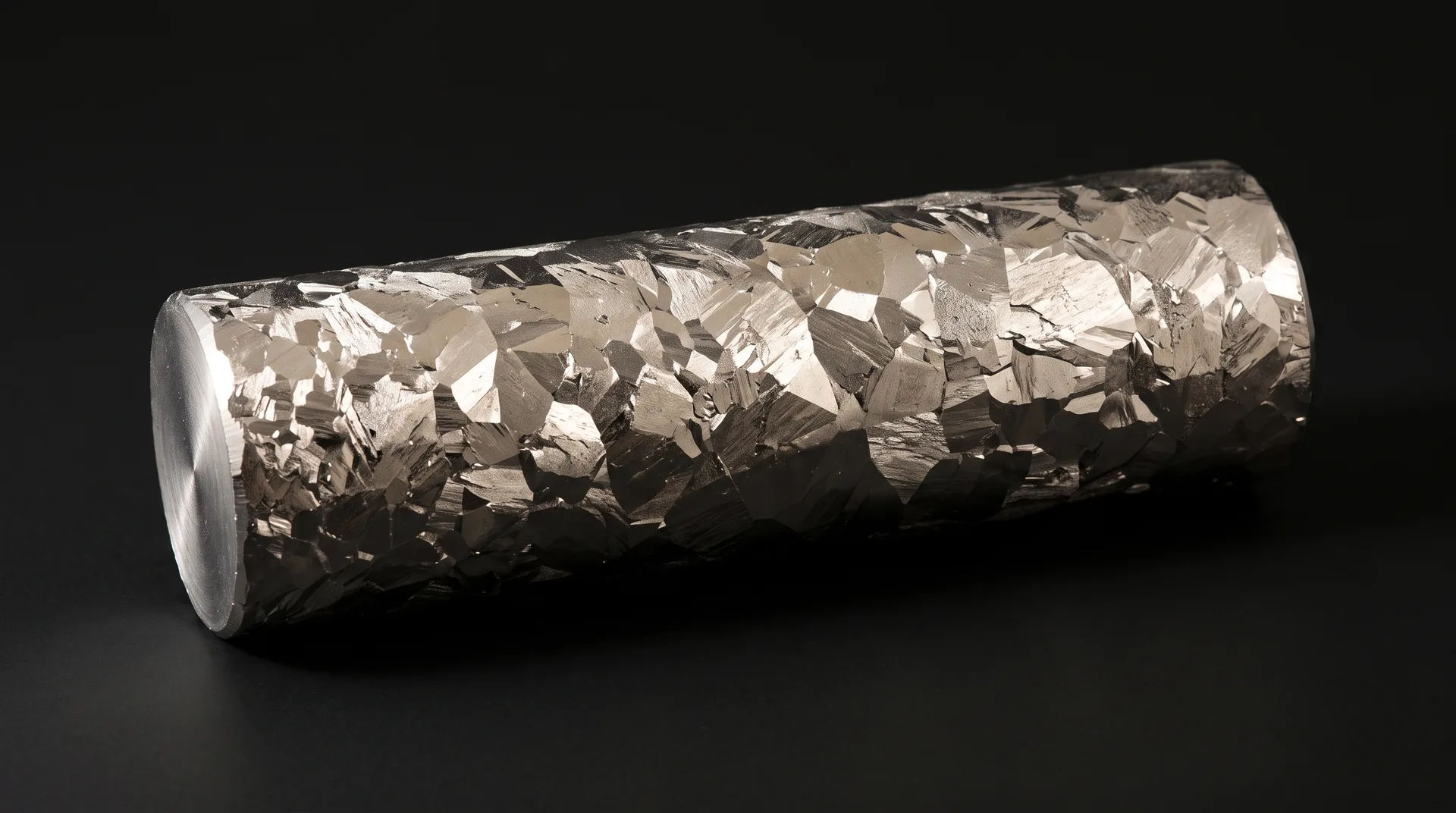
Hafnium is element 72, a lustrous, silvery, ductile transition metal sitting in group 4 and period 6 of the d-block, directly below zirconium. Its electron configuration is [Xe] 4f¹⁴ 5d² 6s², its standard atomic weight 178.486, and its chemistry is dominated by the +4 oxidation state. In practice the metal typically appears grey.
Its discovery was a landmark of theory leading experiment. Niels Bohr predicted that element 72 would be a homologue of zirconium — found in zirconium ores, not among the rare earths, where an erroneous earlier claim had placed it. In 1923, Dirk Coster and George von Hevesy, working at Bohr's institute in Copenhagen, identified the element in Norwegian zircon by X-ray spectral analysis and named it for Hafnia, the Latin name of Copenhagen. It was among the last stable elements to be found, hiding for more than a century inside zirconium minerals that chemists had been handling all along.
Properties
Hafnium melts at 2233 °C and boils at 4603 °C, among the higher values for any metal. Its density is 13.281 g/cm³ at 20 °C — roughly double zirconium's, one of the few easy ways to tell the two apart. At room temperature it takes a hexagonal close-packed structure, converting to a body-centred cubic form at 2388 K.
Its surface chemistry mirrors zirconium's: a thin, self-forming film of monoclinic HfO₂ gives the metal strong corrosion resistance, and it withstands concentrated alkalis. At elevated temperatures it reacts with oxygen, nitrogen, carbon, boron, sulphur and silicon, and it absorbs hydrogen rapidly at 700 °C. Finely divided hafnium is pyrophoric.
Six isotopes occur in nature, with ¹⁸⁰Hf the most abundant at 35.12%. Five of the six are only observationally stable. ¹⁷⁴Hf undergoes alpha decay with a half-life most recently measured at 3.8×10¹⁶ years — about 2.7 million times the age of the universe; some reference tables still carry a 1961 value roughly nineteen times shorter. ¹⁷⁶Hf is radiogenic, produced by the decay of ¹⁷⁶Lu, which makes hafnium's isotopic composition a geological clock. The extinct isotope ¹⁸²Hf (half-life 8.90 million years) underpins hafnium–tungsten dating of planetary core formation. And one nuclear isomer, ¹⁷⁸ᵐ²Hf, stores 2.446 MeV with a 31-year half-life — unusually long, because its de-excitation is quantum-mechanically hindered.
Natural hafnium's thermal-neutron absorption cross-section is about 104 barns, with strong resonances between 1 and 200 eV. The capture resonance integral, about 2000 barns, is a different quantity measured over those resonances.
Occurrence
Hafnium is never found free in nature, and it forms no ores of its own. It occurs invariably inside zirconium minerals, and essentially all of it comes from one: zircon, ZrSiO₄, where zirconium typically outweighs hafnium by roughly 34–36 to 1 by mass per USGS technical publications (a legacy figure of about 50 to 1 persists on USGS overview pages) — about 2–3% hafnium; across zirconium minerals generally the hafnium content runs a broader 1–5%. The upper continental crust carries roughly 3–6 ppm of it.
Its supply chain is therefore an inheritance twice over. Zircon itself is recovered as a coproduct of mining heavy-mineral sands for titanium minerals; hafnium is then a byproduct of processing that zircon. Hafnium is a byproduct of a byproduct — no one has ever mined for it directly.
The pairing with zirconium is no accident of geology but of atomic structure. The lanthanide contraction — the steady shrinkage of atoms across the lanthanide series — leaves Hf(IV) at 0.83 Å almost exactly the size of Zr(IV) at 0.84 Å (Shannon radii, coordination number 8). Two ions of the same charge and effectively the same size behave almost identically in any crystal or solution, so wherever nature puts zirconium, hafnium rides along.
Applications
Hafnium's applications map directly onto three properties. Its appetite for neutrons — a thermal cross-section of ~104 barns against zirconium's ~0.18, roughly 600 times greater — combined with excellent mechanical properties and corrosion resistance makes it a control-rod material for nuclear reactors, particularly naval reactors. The leading use of the metal, though, is in nickel-based superalloys for jet-engine hot sections, where it strengthens grain boundaries and improves the adherence of protective oxide scales under thermal cycling — worth roughly 50 °C of service temperature at about 1% hafnium. In plasma-arc cutting, hafnium inserts serve as the electrode tip that survives an oxidising arc.
Its oxide had a second, quieter revolution. As transistors shrank, the silicon-dioxide gate layer became thin enough for electrons to tunnel straight through; HfO₂ — a high-k dielectric, first demonstrated in leading-edge processors in early 2007 — replaced it and let the scaling continue. Hafnium compounds also define the refractory extreme: hafnium carbide and the carbonitrides sit in a contested cluster near 4200–4260 K for the highest melting points of any compounds, and hafnium nitride is the most refractory of all metal nitrides. The textbook claim that "HfTa₄C₅ melts at 4215 °C" is a resolved falsehood — a unit-conversion error from a 1930 paper that reported 4215 K.
Industrial importance
Hafnium's industrial identity is inseparable from zirconium's, and the relationship reverses depending on where you stand. In a reactor's control rods, hafnium's neutron appetite is the whole point; in the fuel cladding a metre away, the same property makes it a contaminant that must be stripped to parts-per-million levels. The element removed as an impurity from one material is the working substance of the other.
Supply follows the same inverted logic. Because hafnium is a byproduct of a byproduct, its availability is set not by demand for hafnium but by demand for titanium minerals and zircon. The metal in jet engines, reactor control rods and microprocessor gates arrives at the end of a chain in which hafnium itself was never the target.
One episode earns its place in the history: the "hafnium controversy" of 1999, in which researchers claimed the ¹⁷⁸ᵐ²Hf isomer could be triggered to release its stored energy on demand. The claim was never independently reproduced, and defence-agency reviews concluded isomer energy storage was impractical. The stored 2.446 MeV is real; the triggerability was not.
How it is extracted
Extraction begins where the ore is: zircon is carbochlorinated, yielding a mixed stream of zirconium and hafnium tetrachlorides. Then comes the hard part. Separating hafnium from zirconium is among the most difficult separations of any element pair, precisely because their chemistry is so alike; single-stage separation factors are low — around 2 for extractive distillation, 7 for the MIBK solvent-extraction route, 10 for TBP — so the process must run in many stages. Fractional crystallisation of the double fluorides (K₂ZrF₆/K₂HfF₆) — the original von Hevesy–Jantzen separation route — remains in industrial use in Russia. The metal is then produced by Kroll reduction of HfCl₄ with magnesium or sodium, and ultra-pure hafnium is made by the van Arkel–de Boer crystal-bar process, in which the iodide decomposes on a hot tungsten filament.
The nuclear industry runs this separation in both directions at once. Reactor-grade zirconium must contain less than 100 ppm hafnium; the hafnium removed becomes the feedstock for control rods. Each side's waste is the other's feedstock.
- PRIMARYCIAAW — standard atomic weight (2019); isotopic abundances; discovery history; isotopic variation
- PRIMARYIUPAC Standard Atomic Weights 2021 (Prohaska et al.) — abridged atomic weight
- PRIMARYLos Alamos National Laboratory (LANL) — properties, chemistry, separation difficulty, control-rod properties
- SECONDARYWikipedia — Hafnium; physical data (CRC-referenced); allotropy; Kroll and crystal-bar routes
- PRIMARYBelli et al., Nuclear Physics A (2025) — ¹⁷⁴Hf half-life; isomer physics
- PRIMARYNUBASE2020 / IAEA — ¹⁸²Hf half-life
- PRIMARYKleine & Walker 2017 — Hf–W chronometry
- PRIMARYHelmer & Reich 1973 — ¹⁷⁸ᵐ²Hf characterisation
- PRIMARYUSGS Professional Paper 1802–V, Zirconium and Hafnium — occurrence, byproduct status, end uses, Zr:Hf ratio (see also MCS 2024 and Minerals Yearbook 2021)
- PRIMARYShannon 1976 (ionic radii) — lanthanide contraction values
- PRIMARYBanda & Lee, Separation & Purification Reviews 44(3), 199–215, 2015 — Zr/Hf solvent extraction
- PRIMARYRamakrishnan & Rogozinski, J. Phys. D 1997 — plasma-arc electrodes
- PRIMARYMistry et al., IEDM 2007, 247–250 — 45 nm high-k + metal gate
- PRIMARYOECD/NEA — capture resonance integral
- PRIMARYZimmerman, APS News 2007 — the hafnium controversy