Minerals Hub / Mining & Production / From outcrop to 187.8 metres: what the maiden drilling found
Mining & Production · Rutile · 5 min read
From outcrop to 187.8 metres: what the maiden drilling found
Osmond's first holes turned a mineralised outcrop into a downhole discovery — rutile-rich, with a step-out nearly ten kilometres away that Osmond interprets to correlate.
Reviewed by Peter Uppal
The short version
Osmond's Zone 1 discovery hole AV-01bis returned a single 3-metre interval grading 13.20% TiO₂, with that one interval estimated at about 8.0% zircon and roughly 40% heavy minerals — a per-interval estimate, not a deposit-wide grade. These mineral percentages are mass-balance estimates — calculated from oxide assays rather than directly measured — and that basis applies to every mineral percentage in this article. Step-out holes about 9.5 km northwest returned mineralisation Osmond interprets as correlating with the discovery layer, with NWOR-04 returning 2.10 m at 5.20% TiO₂. As at 19 February 2026 the program stood at nine holes for 2,806 metres, with assays still pending on several. These are exploration results — there is no resource yet.
The discovery hole
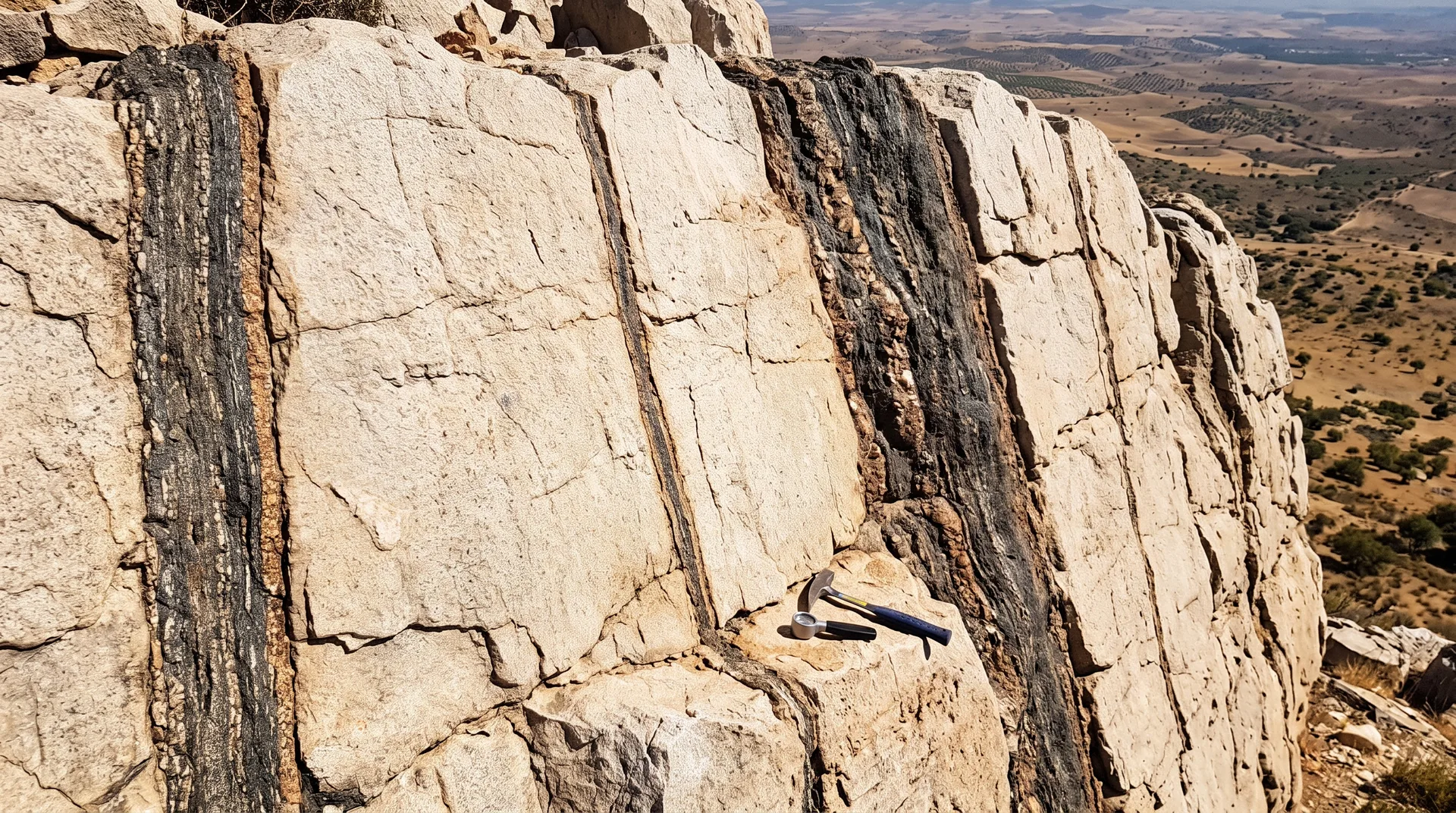
Orión's first real proof came from Zone 1, where mineralised sand seams reach the surface. Drilling beneath one of those outcrops, Osmond's discovery holes turned a mappable layer into a downhole grade.
AV-01 was drilled to a total depth of 187.8 metres and returned a 3-metre interval grading 10.39% TiO₂, with about 6.1% zircon and roughly 30% heavy minerals (mass-balance). Its twin, AV-01bis, drilled alongside it, did better: a 3-metre interval at 13.20% TiO₂, about 8.0% zircon, and roughly 40% heavy minerals (mass-balance) — the single highest heavy-mineral estimate reported at the project to date. Both discovery-hole intervals are carried here as Osmond reported them; the cut-off basis governing them is set by the release that first reported them — the 24 November 2025 discovery release, which states a 3% TiO₂ cut-off (per the project record; that release is not otherwise among this article's cited sources).
Those are strong numbers for a titanium-mineral placer, and they did the essential first job of any discovery hole: they confirmed that the grade seen at surface continues into rock.
Rutile-dominant, on Osmond's own description
The featured mineral here is rutile. In the Zone 1 bulk channel samples, rutile runs 13.36% to 13.49%, and the AV-01bis discovery interval is estimated at around 13.0% rutile (mass-balance; osm_grade, 19 Feb 2026).
Osmond's own testwork carries the characterisation: the company describes its initial titanium product as a mixed titanium concentrate with high rutile content, with dedicated titanium testwork ongoing as at that release (osm_zircon, 3 Mar 2026). Which titanium mineral carries the grade is a question for that testwork to answer, and this article does not answer it ahead of the assays.
Nearly ten kilometres away — an interpreted correlation
A single rich hole is a discovery; a deposit needs continuity. So Osmond stepped out roughly 9.5 kilometres to the northwest, into Zone 3, with holes NWOR-03 and NWOR-04 — the fourth and fifth holes drilled.
The step-out holes returned mineralisation. Osmond reports these intercepts against weighted-average cut-off grades of 2%, 5% and 8% TiO₂ (primary, secondary and ternary) — a cut-off being simply the minimum grade a layer must average to be counted, a standard way to separate ore-grade material from waste, not a claim about economics (osm_grade, 19 Feb 2026). On that basis, NWOR-04 returned an Upper Layer intercept of 2.10 m at 5.20% TiO₂ (including a higher-grade 1.50 m at 5.62%) at the 5% cut-off, plus deeper layers, in a hole drilled to 308.5 m. NWOR-03 returned 3.00 m at 3.49% TiO₂, including a sharp 0.30 m at 6.29% (same 2/5/8% cut-off scheme, per the release).
These grades are lower than the Zone 1 discovery. Osmond's word for the link between the zones is careful — the Zone 1 "Main Layer" is "interpreted to correlate" with Zone 3's Layer 3 (osm_grade, 19 Feb 2026) — an interpretation, not a demonstrated single seam running the full 9.5 km. The significance the company draws is spatial rather than grade-based; this article reports that interpretation as an interpretation and does not extend it.
What "maiden drilling" actually means here
It's worth being precise about the stage. As at 19 February 2026, Osmond had completed nine holes for 2,806 metres, with assays still pending on several of them (osm_grade). AV-01 and AV-01bis are the high-grade Zone 1 discovery; NWOR-03 and NWOR-04 are the regional step-out. That is early-stage drilling — enough to confirm a discovery and to support an interpreted correlation between the zones, not enough to define a resource.
No JORC Mineral Resource has been estimated, and no tonnage exists. What the maiden drilling found is a rutile-dominant, heavy-mineral-rich layer that outcrops and continues downhole, with mineralisation ~9.5 km away that Osmond interprets as the same layer. Turning that into a resource is the job of the estimate Osmond has targeted for Q3 CY26 — and of the assays still to come.
In a titanium placer, which mineral carries the titanium matters as much as how much titanium there is.
Orión data card — Rutile
| Status | Assayed / quantified — exploration results only |
| Bulk channel samples | Rutile 13.36–13.49% (mass-balance; osm_grade, 19 Feb 2026) |
| Discovery interval (AV-01bis, 3 m) | 13.20% TiO₂ · ~13.0% rutile · ~8.0% zircon · ~40% heavy minerals (mass-balance; 3% TiO₂ cut-off per the 24 Nov 2025 release, via the project record) |
| Step-out (NWOR-04 Upper) | 2.10 m @ 5.20% TiO₂ (incl. 1.50 m @ 5.62%), 5% TiO₂ cut-off (osm_grade) |
| Assemblage | Osmond describes a mixed titanium concentrate with high rutile content; dedicated Ti testwork ongoing as at 3 Mar 2026 (osm_zircon) |
| Program | 9 holes / 2,806 m as at 19 Feb 2026; assays pending on several (osm_grade) |
| Sources | osm_grade (19 Feb 2026); osm_zircon (3 Mar 2026); osm_drivers (3 Jul 2026) |
→ See the full Rutile dossier in the mineral hub.
Exploration results and mineralogical estimates only. Orión has no JORC-compliant Mineral Resource or Reserve; maiden MRE and Scoping Study pending, targeted Q3 CY26.
Related reading
- Reading the Orión seams: what the heavy-mineral layers tell us (The Deposit · Zircon)
- Rutile vs ilmenite: why the split matters (Science · Rutile, Ilmenite)
- Why aerospace still can't design titanium out (Applications · Rutile)
Sources
- PRIMARYosm_grade — ASX:OSM release, 19 Feb 2026, 'High-Grade Assay Results Confirm Potential Scale at Orión' (NWOR-03/04 intercepts Tables 1–2; bulk & discovery-hole grades Table 3; cut-off definitions p.1/p.17; program status p.1, p.5; collar table Appendix A).
- PRIMARYosm_zircon — ASX:OSM release, 3 Mar 2026, 'Preliminary Mineral Processing Testwork Delivers Strong Zircon and Monazite Results' (rutile-dominant Ti concentrate, p.4).
- PRIMARYosm_drivers — ASX:OSM release, 3 Jul 2026, 'Positive Initiatives to Drive Shareholder Value' (heavy minerals 'up to 30%', p.1).