Minerals Hub / Mining & Production / Breaking rock without breaking the grains
Mining & Production · Rutile · 6 min read
Breaking rock without breaking the grains
When a placer has turned to stone, a crushing stage appears at the front of the flowsheet — and how hard you crush decides what the plant can still recover.
Reviewed by Peter Uppal
The short version
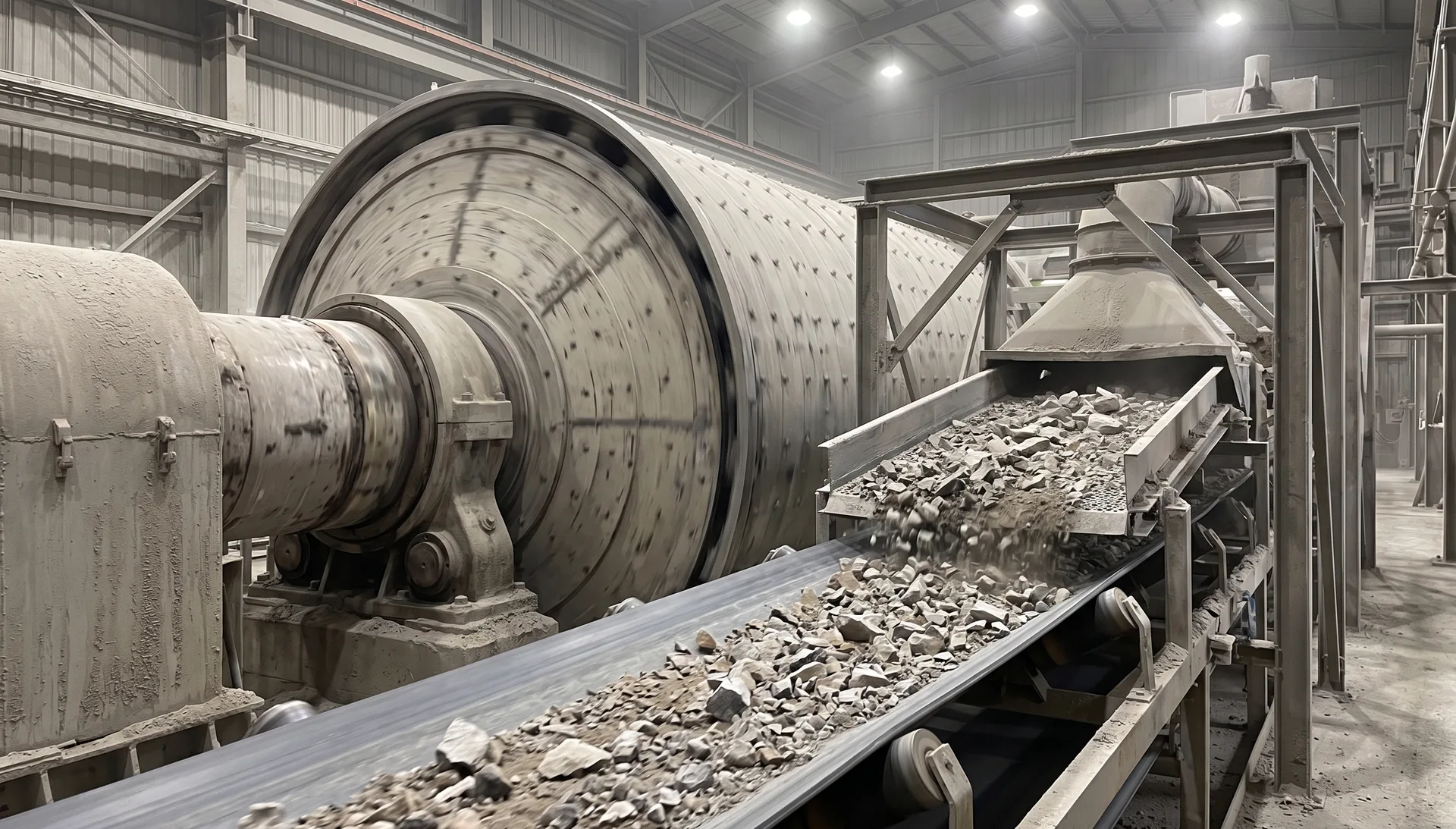
Most heavy-mineral sands deposits are unconsolidated to poorly consolidated, which is why they are generally easy to excavate; a lithified placer is rock, and rock has to be broken before its grains can be sorted. That inserts a comminution stage ahead of separation, and comminution is where the two halves of the problem meet: grains still locked in the matrix behave in a separator as the particle behaves, not as the mineral would, while grains crushed too far fall below the size at which gravity separation works well. Both errors send value to the same tailings stream.
The ordinary case, and why Orión is not it
The USGS deposit model for heavy-mineral sands describes the normal condition of this deposit type directly: most heavy-mineral sands deposits range in coherence from unconsolidated to poorly consolidated, and are for that reason generally easy to excavate. The same report characterises the sands themselves as typically well sorted, medium- to fine-grained, well-rounded, and not indurated.
Osmond describes Orión differently. Its releases characterise the deposit as a lithified tidal-sand placer hosted in weakly laminated quartzite correlated with the Pochico Formation, carrying rutile, ilmenite, zircon and monazite, with heavy-mineral layers reported at 0.3 to 4.0 m thick. The sorting that concentrated those minerals happened the way it happens on any beach. What is different is what happened afterwards: the sand was buried and cemented, and the deposit is now quartzite.
That single word reorganises the front of any flowsheet built on it. It is worth being precise about why.
What a separator is actually looking at
The useful frame comes from particle-based process modelling rather than from mineralogy. As a general statement of how mineral processing works — not an Osmond disclosure — the output of a comminution circuit consists of polymineralic, not monomineralic, ore particles; consequently, sorting devices do not act on pure mineral properties, but on particle properties.
That is the whole of it. A spiral does not see rutile. It sees a particle, and responds to that particle's density. A grain of rutile still cemented into a fragment of quartzite is, to the spiral, a lower-density particle than rutile — and it reports accordingly. Comminution is described in the same reference as the process of reducing the particle size of an ore to liberate the ore minerals from the gangue minerals: breaking the rock is not a preparation step before the real work, it is the step that decides whether the real work can happen at all.
In a loose placer this problem is largely absent, because the grains were separated by the same water that sorted them. Even there some sizing happens at the front end — trade coverage of one mobile mining unit describes run-of-mine ore crushed to a size suitable for pumping as slurry — but that is sizing for transport, not liberation. In a lithified placer, liberation is a real and unavoidable duty.
The window the crushing has to land in
Here is the constraint that makes this a genuine trade-off rather than a matter of crushing harder.
Gravity separation, the first concentration stage in a heavy-mineral circuit, has a size range within which it works and outside which it degrades. A conference paper on spiral performance states that the most efficient size range is between 45 and 500 microns in heavy-mineral sands applications. Below that, the same paper reports work finding that the recovery of very fine particles under 53 microns might only reach 30% maximum, and describes how very fine heavy particles below approximately 75 microns are typically swept up in the highly turbulent outer regions of existing trough designs and are lost to tailings. Those figures carry their authors' hedges — "most efficient", "might only reach", "typically", "approximately" — and they should be read with them; they describe a degradation, not a cliff.
Set the two constraints side by side and the shape of the decision appears. Crush too little and the valuable grains stay locked in quartzite fragments, and the separator reads them as gangue. Crush too much and the freed grains go below the size where the separator holds them, and they leave in the same stream. The tailings do not record which mistake was made.
Crush too little and the mineral is still in the rock. Crush too far and it is out of the rock and out of the window. The tailings look identical either way.
This much is reasoning from the sourced limits rather than a documented operating result. We could not locate a public description of an operating cemented or hard-rock-hosted heavy-mineral placer with its comminution circuit set out, which would be the natural place to see how the balance is struck in practice.
What is on the record at Orión, and what is not
Osmond has published preliminary metallurgical testwork and no flowsheet that can be cited here. What the testwork does show is that fine streams are already part of the picture: the monazite result was produced via a -38 micron flotation and WHIMS stream — that is, deliberately below the range in which spirals are described as most efficient, using methods chosen for fine material rather than gravity.
That is not a contradiction. It is the ordinary structure of a heavy-mineral circuit, in which different minerals are recovered by different means at different sizes. But it is a reminder that "how hard do we crush" is not answered once for the ore. It is answered differently for each product the ore is meant to yield, and the answers constrain one another. What the balance would be at Orión is a question for the metallurgical programme and the pending study, and Osmond has not published an answer to it.
Exploration results and mineralogical estimates only. Orión has no JORC-compliant Mineral Resource or Reserve; maiden MRE and Scoping Study pending.
Sources
- USGS SIR 2010-5070-L — Deposit model for heavy-mineral sands in coastal environments
- Elements, December 2023 — All About Particles: Modelling Ore Behaviour in Mineral Processing
- IMPC 2020 — Spiral conditions for the recovery of ultra-fine particles
- International Mining — Chemours mobile mining units, 13 July 2021
- Osmond figures: osm_grade — 19 February 2026; osm_zircon — 3 March 2026 (ASX:OSM releases)
Related reading
- How two properties sort four minerals picks up where this article stops, at the separators that receive whatever the crushing stage hands them.
- Automating a mine that keeps moving takes the other consequence of ground conditions, which is what the mining operation itself has to look like.
- What a thorium channel can and cannot see explains why a deposit like this one is found at outcrop before it is found at depth.
- What a lithified placer actually is (Science · The deposit explained) sets out the geology this article takes as given.
Sources
- PRIMARYUSGS Scientific Investigations Report 2010-5070-L, Van Gosen and others, 'Deposit model for heavy-mineral sands in coastal environments' (coherence of heavy-mineral sands deposits and ease of excavation; sands typically well sorted, medium- to fine-grained, well-rounded and not indurated).
- PRIMARYPereira, Schach, Tolosana-Delgado and Frenzel, 'All About Particles: Modelling Ore Behaviour in Mineral Processing', Elements, vol. 19 no. 6, December 2023 (definition of comminution and liberation; polymineralic particles; sorting devices act on particle properties).
- SECONDARYBornman, Foisy and Naude, 'Spiral conditions for the recovery of ultra-fine particles', IMPC 2020: XXX International Mineral Processing Congress, Cape Town, 18-22 October 2020 (efficient spiral size range in heavy-mineral sands; ultra-fine recovery limits; loss of sub-75 micron heavy particles to tailings).
- PRIMARYosm_grade — ASX:OSM release, 19 February 2026 (Orión described as a lithified tidal-sand placer in weakly laminated Pochico Formation quartzite; economic minerals rutile, ilmenite, zircon, monazite; heavy-mineral layers 0.3-4.0 m thick).
- PRIMARYosm_zircon — ASX:OSM release, 3 March 2026 (preliminary metallurgical testwork at SGS; monazite recovered via a -38 micron flotation / WHIMS stream).
- SECONDARYInternational Mining, 'Chemours deploying Mineral Technologies' mobile mining units at Trail Ridge South mineral sands mine', 13 July 2021 (run-of-mine ore crushed to a size suitable for pumping as slurry).
- UNVERIFIEDGAP: no publicly documented operating example of a cemented or hard-rock-hosted heavy-mineral placer, with its front-end comminution circuit described, could be located at drafting. The two-sided loss argument in this article is therefore reasoned from the sourced size limits above, not from an operating case.Non-public document · no public URL